Running Facebook Ads does not cost the same for every business. Two businesses can advertise in the same city, spend the same budget, and still receive different results. One may reach thousands of people at a relatively low cost, while the other may pay more to reach a smaller audience.
Why does this happen?
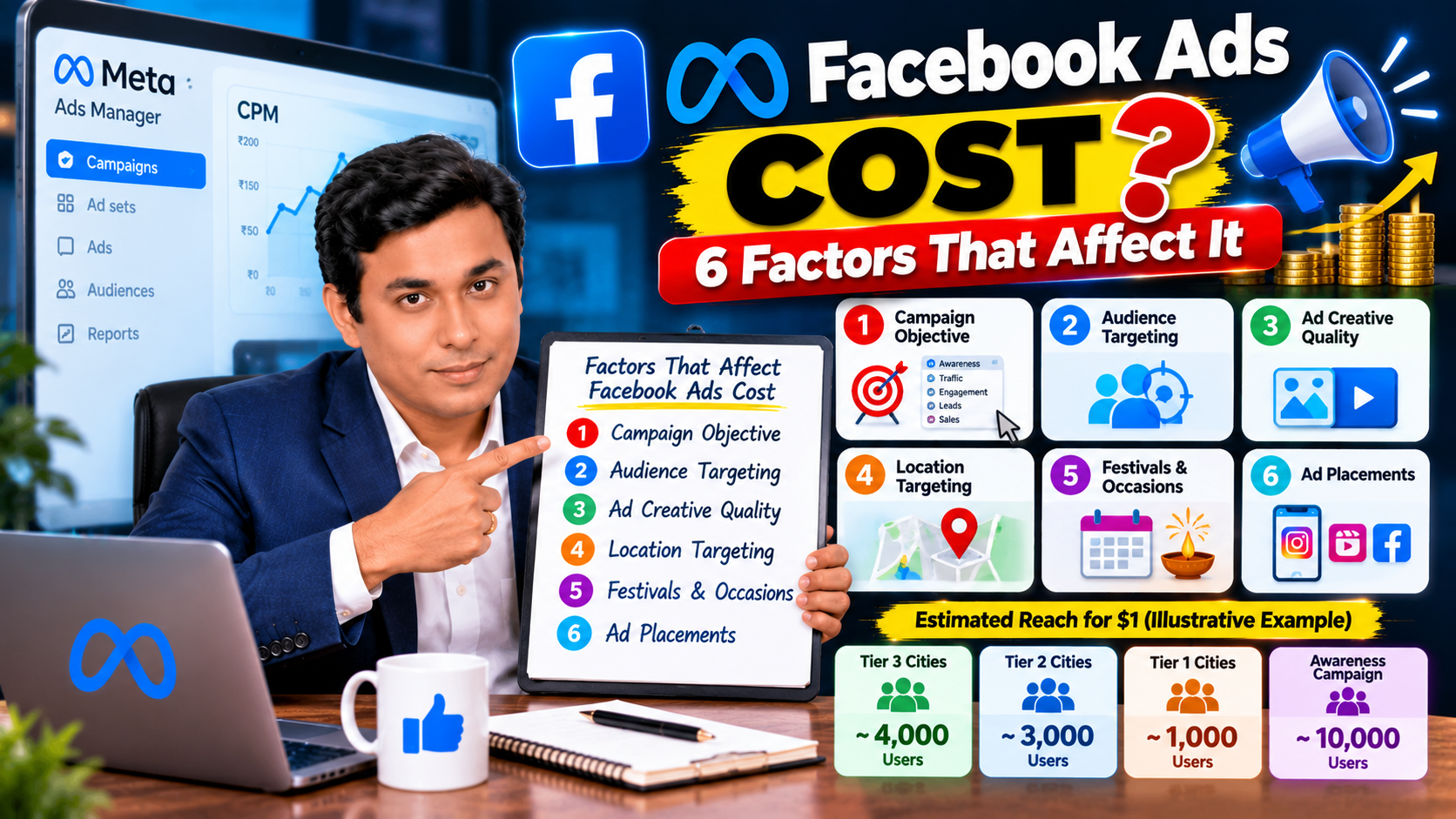
The cost of Facebook Ads, now part of Meta Ads, depends on several factors, including your campaign objective, audience targeting, creative quality, location, seasonal demand, and ad placements.
In my experience working with digital marketing campaigns, one of the most important things to understand is that a lower advertising cost does not automatically mean better business results. Cheap impressions can help increase visibility, but businesses that want leads or sales need to evaluate the quality of their results as well.
Let’s understand the six major factors that influence Facebook Ads costs.
1. Campaign Objective
Your campaign objective is one of the first things to consider when estimating Facebook Ads costs.
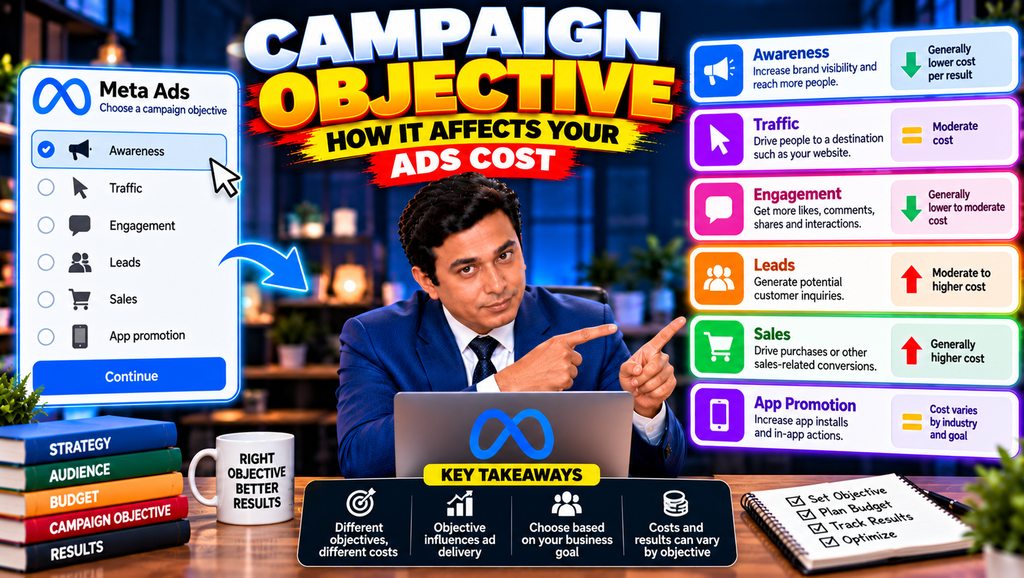
Meta Ads offers objectives such as Awareness, Traffic, Engagement, Leads, Sales, and App Promotion. Each objective tells Meta what type of result you want to achieve, influencing how the platform delivers your ads.
For example, an Awareness campaign aims to increase brand visibility. A Traffic campaign focuses on driving people to a destination, such as a website. An Engagement campaign seeks interactions, while a Leads campaign is designed to generate potential customer inquiries. A Sales campaign is intended to help businesses generate purchases or other sales-related conversions.
Because the objectives differ, their costs and results can differ too.
Awareness campaigns
Awareness campaigns can be useful for businesses that want more people to discover their brand, product, or service.
A local clothing store launching a new collection may want to introduce its products to as many relevant people as possible. In this situation, reach and impressions may be more important than immediate purchases.
However, an Awareness campaign should not be judged by the same standards as a Sales campaign.
Traffic campaigns
Traffic campaigns focus on bringing people to a website, landing page, or another destination.
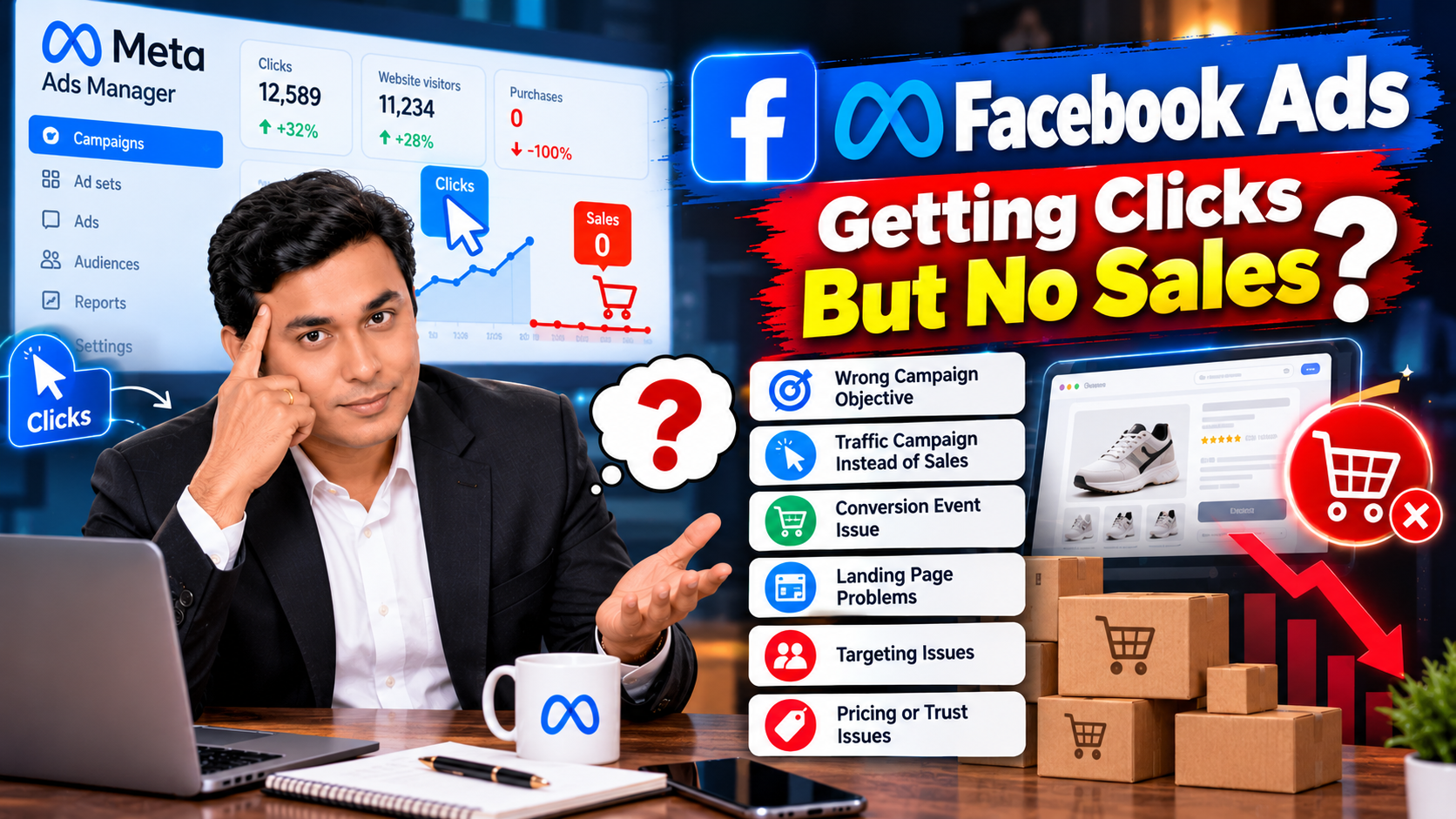
They can be useful when website visits are the primary goal. However, a person who clicks an advertisement is not necessarily ready to buy.
For example, a business might receive many website visits but very few purchases if its campaign is optimized for traffic rather than sales.
Engagement campaigns
Engagement campaigns can help businesses encourage interactions, depending on the selected performance goal. These interactions may include likes, comments, video views, or messages.
A campaign optimized for engagement should not automatically be expected to produce the same quality of leads as a campaign optimized for lead generation.
Leads and Sales campaigns
Leads campaigns focus on generating potential customer inquiries, while Sales campaigns are designed to encourage purchases or other relevant conversion actions.
These campaigns may have higher CPMs than some reach-focused campaigns, but that is not guaranteed. Their costs depend on competition, audience, creative, and the optimization goal.
My recommendation: Select your campaign objective according to your actual business goal. Do not choose Traffic simply because clicks are cheap if what you really need is qualified leads or purchases.
2. Audience Targeting
Audience targeting is another important factor that affects Facebook Ads costs.
Your audience can influence the competition you face in Meta’s advertising auction. A broad audience may offer more opportunities to deliver ads, while a narrow audience can be more expensive when many advertisers compete for the same people.
Consider two examples.
A restaurant promoting a new menu might target people interested in food, dining, or local restaurants. A premium chandelier retailer may target a narrower group of people interested in interior design, luxury home decor, and premium furnishings.
The second audience could be more expensive to reach in some circumstances, particularly when the audience is small or advertiser competition is high.
However, narrower targeting does not always mean a higher CPM. The outcome depends on the audience, campaign settings, competition, and how Meta can deliver the ad.
Does a broader audience always cost less?
No. A broader audience can provide more delivery opportunities, but the cost depends on more than audience size alone.
For example, a broad audience for a highly competitive product may still be expensive. A smaller local audience could be relatively affordable if competition is low.
The important thing is to evaluate both the cost of reaching people and the quality of the resulting traffic, leads, or purchases.
3. Ad Creative Quality
Your ad creative includes the image or video, headline, primary text, offer, and overall presentation of your advertisement.
Creative quality can influence how people respond to your ad and how it performs in Meta’s auction.
An advertisement with clear messaging and relevant visuals may attract more attention than one that looks confusing, unprofessional, or unrelated to the audience’s needs.
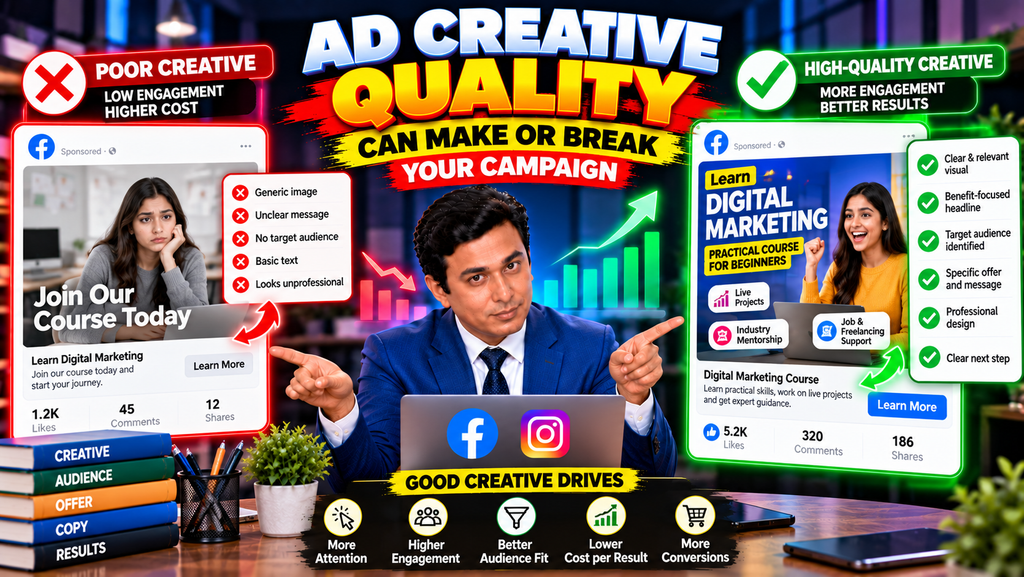
For example, imagine a coaching institute advertising its digital marketing course.
The first ad uses a generic image and says, “Join Our Course Today.”
The second ad uses a clear visual, communicates a relevant benefit, identifies the intended audience, and provides a straightforward next step.
The second advertisement may generate a better response if its message matches the audience’s needs.
How can better creatives influence costs?
Meta’s ad auction considers factors beyond the amount an advertiser bids, including estimated action rates and ad quality. Therefore, creative performance can influence delivery and costs.
To improve your creatives:
- Use clear, relevant visuals.
- Communicate one primary benefit.
- Make your offer easy to understand.
- Match the creative to the audience and campaign objective.
- Test different hooks, formats, and messages.
- Avoid misleading claims and unnecessary clickbait.
Remember that a high engagement rate alone does not prove an ad will generate sales. Track the metric that matters to your business.
4. Location Targeting
The location you target can influence your Facebook Ads costs because advertising competition and audience demand differ across markets.
For example, an advertiser targeting a major metropolitan market may compete with national brands, established businesses, and other advertisers bidding for similar audiences.
A business targeting a smaller city or a specific local service area may encounter a different level of competition.
This is why some advertisers find it more affordable to reach audiences in smaller Indian cities than in major metropolitan areas.
However, city categories such as Tier 1, Tier 2, and Tier 3 are broad classifications. They do not guarantee a particular CPM or a fixed advertising cost.
Example: Comparing locations in India
Suppose a business wants to advertise a local service in Jaipur, Delhi, and a smaller Rajasthan city.
Its CPM may differ across these locations because of factors such as audience demand, advertiser competition, age and interest settings, and the campaign objective.
The same business may also see different results at different times of the year.
Practical tip: Compare location performance inside Ads Manager instead of assuming that every smaller city will be cheaper or that every metropolitan audience will be expensive. Most importantly, evaluate the quality of leads and sales generated from each location.
5. Festivals, Occasions, Weekends, and Seasonal Demand
Seasonality can have a significant impact on advertising costs.
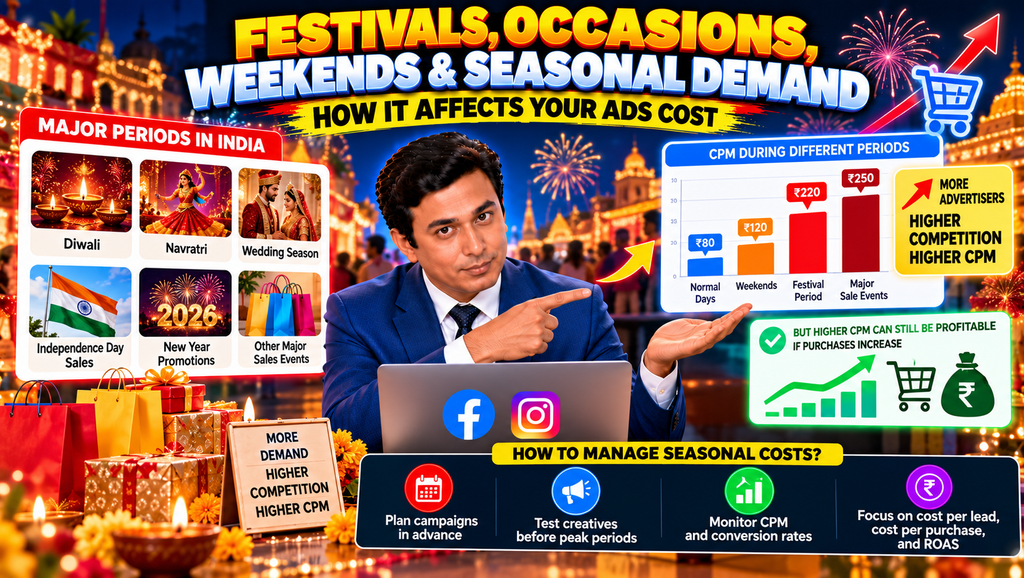
During festivals, major shopping events, and popular sales periods, many businesses increase their advertising activity. This can increase competition for the audiences they want to reach.
In India, advertisers may see changes around Diwali, Navratri, wedding seasons, Independence Day sales, New Year promotions, and other important commercial periods.
For example, a jewellery retailer may increase its advertising budget before Diwali because customers are actively considering jewellery purchases. At the same time, competing jewellery stores and other retail brands may also increase their spending.
When more advertisers compete for similar audiences, CPM can rise.
However, the effect is not identical across every industry or campaign. Some businesses may experience a noticeable increase, while others may see a smaller change or no meaningful increase at all.
How should businesses manage seasonal costs?
Plan campaigns in advance, test creatives before peak periods, and monitor CPM alongside conversion rates.
Do not judge a seasonal campaign only by whether its CPM is higher. If customers are more likely to purchase during that period, a higher CPM may still produce a profitable result.
The key question is whether your cost per lead, cost per purchase, or return on ad spend remains acceptable.
6. Ad Placements
Meta offers different placements across its platforms and surfaces, including Facebook Feed, Instagram Feed, Stories, Reels, Explore, and other eligible placements.
The availability of individual placements depends on your campaign setup, objectives, creative format, and other settings.
Different placements can produce different CPMs because user behaviour, available inventory, competition, and advertiser demand vary.
For example, a vertical video may work well in Stories or Reels, while a product image or detailed promotional graphic may suit a feed placement better.
It is not accurate to assume that Stories and Reels are always more expensive than Facebook Right Column or Instagram Explore. The most cost-effective placement depends on the campaign and audience.
Should you choose manual placements?
Automatic placements can give Meta more flexibility to deliver your ads across eligible placements. Manual placements can be useful when you have a clear reason to focus on specific locations, such as a creative that only works in a particular format.
Instead of choosing placements based on assumptions, compare their actual performance.
Review metrics such as CPM, link click-through rate, landing page views, cost per lead, purchases, and return on ad spend where applicable.
A placement with a low CPM may deliver inexpensive impressions without producing meaningful business outcomes. A more expensive placement may still be worthwhile if it generates better-quality customers.
How Much Reach Can You Get With $1 in Facebook Ads?
The amount of reach you can get from $1 depends on your CPM, campaign settings, audience, and delivery conditions. There is no fixed rate that applies to every business or city.
In your own campaign analysis, you might use illustrative estimates such as the following to explain how location and objective can affect delivery. These figures are examples for planning and should not be treated as guaranteed market benchmarks.
| Illustrative scenario | Possible reach estimate for $1 |
|---|---|
| Traffic campaign targeting a Tier 3 city | Around 4,000 people |
| Traffic campaign targeting a Tier 2 city | Around 3,000 people |
| Traffic campaign targeting a Tier 1 city | Around 1,000 people |
| Awareness campaign with inexpensive delivery | Potentially around 10,000 people |
These estimates are not universal. Actual reach can be lower or higher, and reach is different from impressions. One person may see an advertisement more than once.
It is also important to distinguish reach from results. An Awareness campaign may help a business reach more people, but that does not mean it will generate the same number of leads or purchases as a campaign optimized for those outcomes.
Before using these figures in a business proposal or advertising budget, validate them against recent campaign data from your own account.
How to Estimate Your Facebook Ads Cost More Accurately
Rather than relying only on generic CPM estimates, use your campaign data to build a realistic budget.
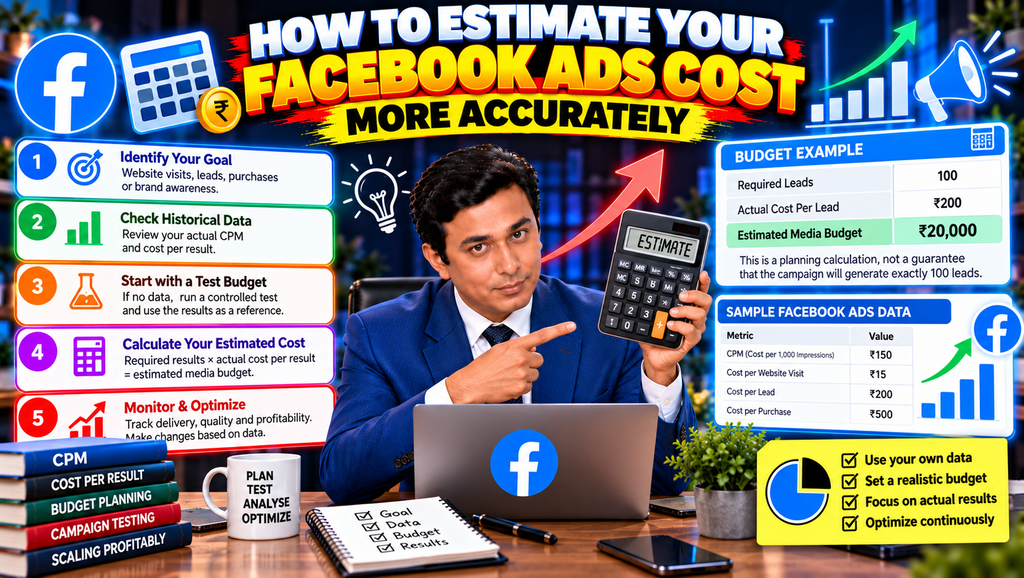
Start by identifying the result you want: website visits, leads, purchases, or brand awareness.
Next, review your historical CPM and cost per result for similar campaigns. If you have no previous data, begin with a controlled test budget and use the initial results as a reference, not a guarantee.
For example, if you need 100 leads and your actual cost per lead is ₹200, your estimated media budget would be ₹20,000. This is a planning calculation, not a promise that the campaign will generate exactly 100 leads.
As the campaign runs, monitor delivery, lead quality, purchases, and profitability. Make changes based on meaningful evidence rather than reacting to every short-term fluctuation.
Frequently Asked Questions
1. What is CPM in Facebook Ads?
CPM means cost per thousand impressions. It tells you how much you spend, on average, for every 1,000 times your advertisement is shown.
2. Why is my Facebook Ads CPM high?
Your CPM may be influenced by advertiser competition, audience demand, campaign objective, placements, creative performance, seasonal activity, and other campaign settings. Review these factors alongside your cost per result.
3. Are Facebook Ads cheaper in Tier 2 and Tier 3 cities?
They can be cheaper in some situations because competition and audience demand vary by location. However, city tier alone does not determine CPM. Always compare actual campaign performance.
4. Does a low CPM mean better Facebook Ads performance?
No. A low CPM means you are paying less for impressions. It does not necessarily mean you are generating qualified leads, purchases, or profit at a lower cost.
5. Which Facebook Ads objective should I choose for my business?
Choose the objective that aligns with your business goal. Awareness is suitable for visibility, Traffic for visits, Leads for inquiries, and Sales for purchase-focused campaigns. Select the relevant performance goal and conversion setup for your intended outcome.
Final Thoughts
Facebook Ads costs vary because every campaign operates under different conditions. Your objective, audience, creative, location, seasonal competition, and placements can all influence delivery.
If your goal is brand visibility, evaluate reach and impressions. If your goal is lead generation, measure the cost and quality of leads. If your goal is sales, focus on purchases, customer acquisition cost, and profitability.
Do not optimize your advertising budget only to reach more people. Optimize it to achieve the business result you actually need.

Related Posts