If you’re planning to advertise your business online, you’ve probably considered two major platforms: Google Ads and Meta Ads.
Both can help you attract potential customers, generate leads, and increase sales. However, they approach advertising differently.
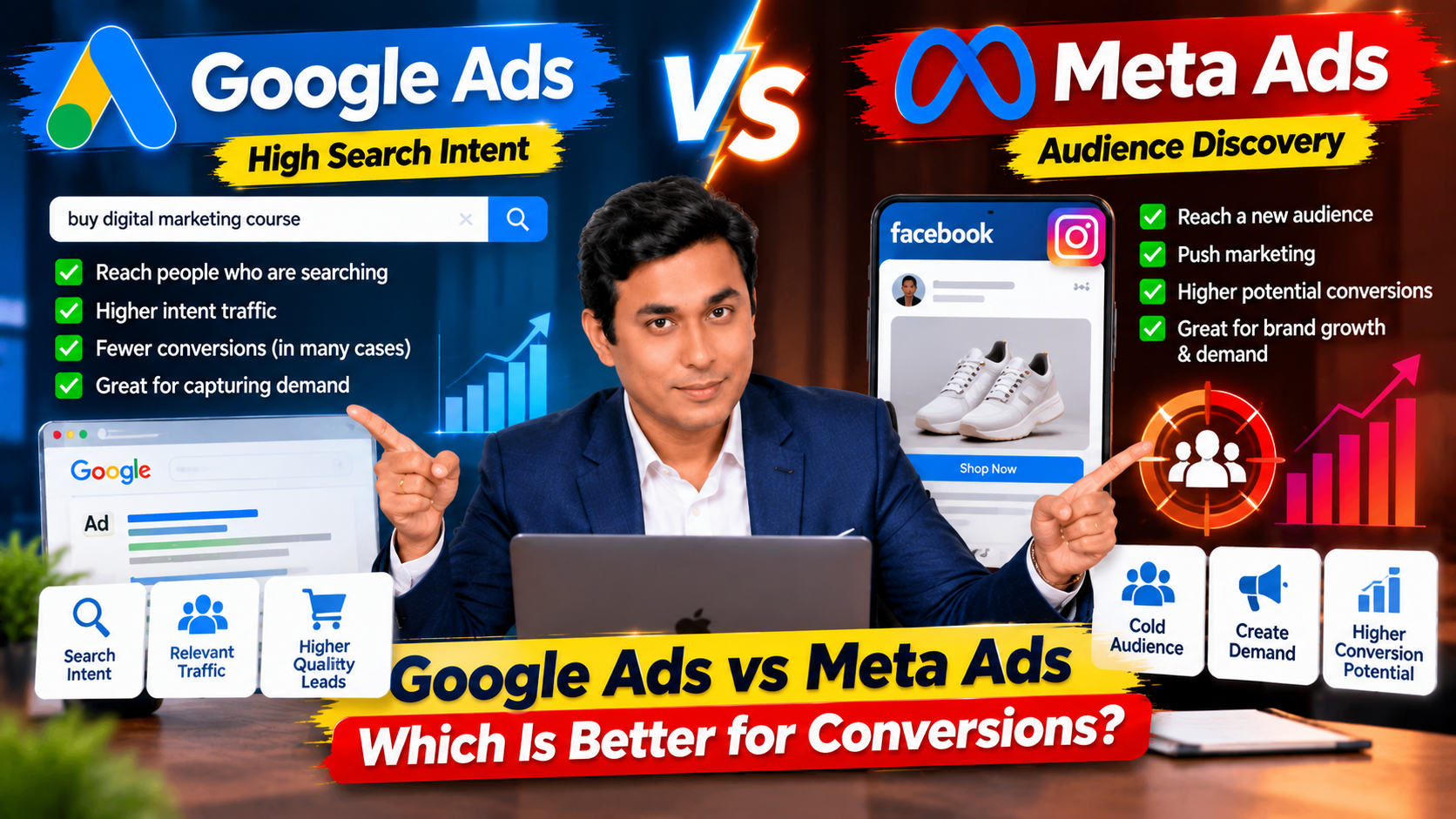
Google Ads can help you reach people who are actively searching for products or services. Meta Ads, which run across platforms such as Facebook and Instagram, can help you introduce your products to people based on their interests, behaviour, and other targeting signals.
But here’s an interesting question: If both platforms can generate conversions, why might one deliver better results than the other for a particular business?
From my experience running digital marketing campaigns, the answer often comes down to search intent, audience behaviour, campaign objectives, and how effectively the campaigns are optimized.
Let’s understand the differences between Google Ads and Meta Ads, when each platform makes sense, and how you can decide where to invest your advertising budget.
What Is the Difference Between Google Ads and Meta Ads?
The biggest difference lies in how businesses reach potential customers.
Google Search Ads generally respond to user searches. When someone searches for a product, service, or solution, your advertisement may appear if your campaign is eligible and relevant.
Meta Ads often work differently. You can introduce your products or services to people who may be interested in them even when they aren’t actively searching for what you sell.
This distinction is commonly described as pull marketing versus push marketing.
- Google Search Ads: Often capture existing demand by reaching people who are actively looking for a solution.
- Meta Ads: Often help create or stimulate demand by introducing an offer to a relevant audience.
- Google Display Ads: Can also introduce your brand to people while they browse websites and apps, rather than waiting for them to search.
These are broad distinctions, not absolute rules. Google offers advertising formats beyond Search, and Meta can reach people who already know your brand or have previously visited your website.
The right choice depends on your business model, customer journey, and advertising objective.
1. Google Ads: Reach People With Higher Search Intent
Imagine you sell a digital marketing course.
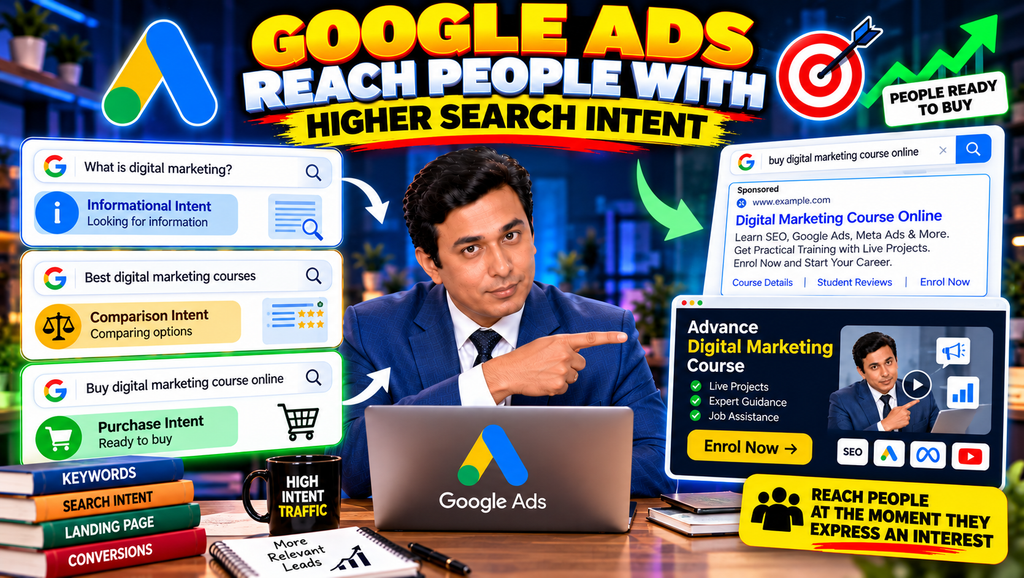
Someone searches Google for “buy digital marketing course online.” This person is actively looking for a course and may be comparing different options before making a purchase.
You can create a Google Search campaign targeting relevant searches and direct users to a landing page where they can explore your course and enrol.
This is one of the biggest advantages of search advertising: you can reach people at the moment they express an interest in a product or service.
However, not every search indicates purchase intent.
Consider these examples:
- “What is digital marketing?” — primarily informational intent.
- “Best digital marketing courses” — comparison or commercial investigation intent.
- “Buy digital marketing course online” — stronger purchase intent.
A campaign focused on immediate sales may benefit from targeting relevant commercial and transactional searches.
But there’s a limitation.
The number of people actively searching for your particular product with strong purchase intent may be relatively small. If your market is narrow, you may eventually reach a point where increasing your budget doesn’t produce proportionally more qualified conversions.
Does Google Ads Always Generate Fewer Conversions?
No. This depends on your industry, demand, competition, campaign settings, and offer.
A business selling emergency plumbing services may generate excellent results from Google Search because customers often search when they urgently need help.
On the other hand, a new fashion brand selling an unfamiliar product may find it difficult to generate significant search volume because potential customers don’t yet know the product exists.
In the second scenario, Meta Ads may help introduce the product to a relevant audience and generate interest that wasn’t previously expressed through search.
The important lesson is to understand how your customers discover and purchase your product before choosing your primary advertising channel.
2. Do Exact Match Keywords Always Deliver Better Conversions?
One common Google Ads misconception is that exact match keywords always outperform phrase match and broad match.
Exact match can be useful when you want greater control over the types of searches your campaign targets. However, it doesn’t guarantee higher conversion rates or better return on advertising spend.
Let’s consider an example.
Suppose you’re advertising an online accounting course.
You might test a keyword such as:
[buy accounting course online]
This can help you target searches with a strong connection to that purchasing intent.
However, Google’s exact match can also match searches with the same meaning or intent, including close variants. It doesn’t mean your advertisement will only appear when someone types the exact characters you entered.
Phrase match and broad match can help discover additional relevant searches. Broad match can be particularly useful when paired with conversion-focused Smart Bidding, although it requires suitable campaign configuration and monitoring.
How Should You Choose Your Keyword Match Types?
Start with your business objective and available data.
If your budget is limited, you may want to begin with highly relevant keywords and carefully monitor the Search terms report. As you gather reliable conversion data, you can test broader targeting where it makes commercial sense.
Don’t judge keywords by clicks alone.
Compare conversion rate, cost per conversion, lead quality, revenue, and return on ad spend (ROAS).
A broad match keyword that generates profitable sales may be more valuable than an exact match keyword that receives very few impressions and no conversions.
The goal isn’t to use the narrowest possible match type. It’s to generate valuable conversions at an acceptable cost.
3. Meta Ads: Reach People Who May Not Be Searching Yet
Now, let’s consider Meta Ads.
Imagine you launch a new skincare product.
Very few people may be searching for your specific brand because it’s new to the market. Even if your product solves a genuine problem, potential customers may not know it exists.
This is where Meta Ads can help.
You can create engaging videos, product demonstrations, customer-focused creatives, and advertisements that introduce your product to a relevant audience.
People might discover your product while browsing Instagram or Facebook, become interested, visit your website, and eventually make a purchase.
This is an example of demand generation.
Unlike search advertising, you don’t necessarily need to wait for customers to search for your specific product or brand before introducing your offer.
Why Can Meta Ads Generate More Conversions?
In some campaigns, Meta Ads can generate more conversions because the platform can reach a much larger audience than the relatively small group of people actively searching for a particular product.
Your advertisement can introduce a product, communicate its benefits, and encourage customers to consider purchasing it.
This can be especially useful for visually appealing products, new brands, impulse purchases, and products that benefit from demonstration.
However, a larger audience doesn’t automatically translate into more sales.
Your creative, offer, product-market fit, website experience, pricing, and campaign setup all influence results.
Meta’s delivery system also uses available signals to identify people likely to take the action you’re optimizing for. The quality of your conversion data and the objective you choose can influence how effectively it does so.
4. Google Ads vs Meta Ads: Which Platform Has a Higher Conversion Rate?
This is where many advertisers make a mistake.
They compare Google Ads and Meta Ads based on the number of conversions without considering the amount spent, traffic quality, conversion definitions, or customer value.
Suppose you run two campaigns for the same business.
The Google Search campaign reaches people searching for a specific service. The Meta campaign introduces that service to a broader audience.
The Search campaign might generate fewer visitors but attract people who are closer to making a purchase. The Meta campaign might generate more website visitors and conversions by reaching a larger audience.
However, the opposite can also happen.
A well-targeted Meta campaign can generate highly qualified enquiries, while a Google campaign can waste money on irrelevant searches if keyword selection and search-term management are poor.
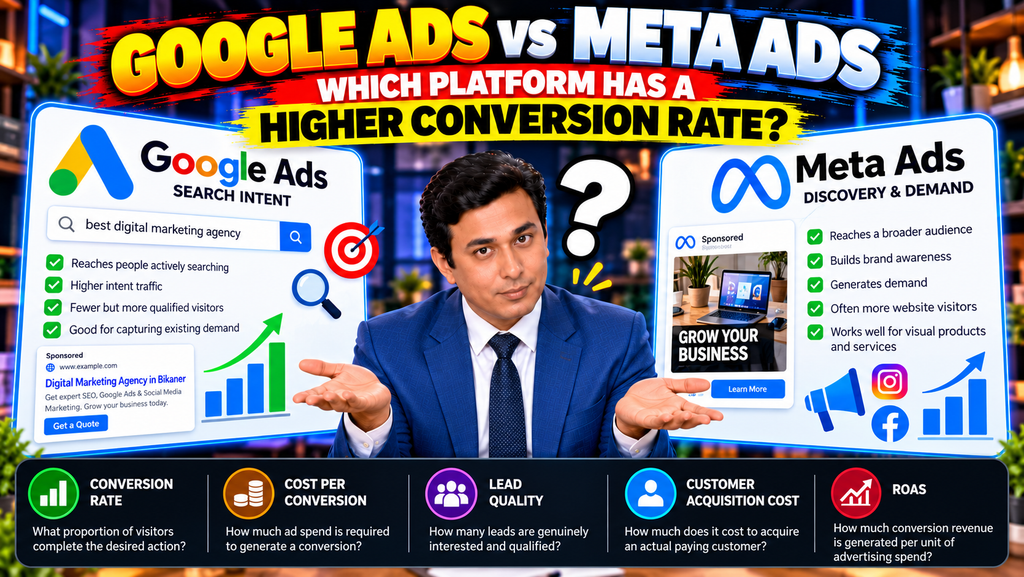
To compare the platforms fairly, measure the following:
- Conversion rate: What proportion of visitors complete the desired action?
- Cost per conversion: How much advertising expenditure is required to generate a conversion?
- Lead quality: How many leads are genuinely interested and qualified?
- Customer acquisition cost: How much does it cost to acquire an actual paying customer?
- ROAS: How much tracked conversion revenue is generated per unit of advertising spend?
For example, one platform might generate inexpensive leads, but those leads may rarely become customers. Another platform might generate fewer leads at a higher initial cost, but those leads could produce more revenue and profit.
The second campaign may be the better investment despite its lower conversion volume.
Also, ensure that both platforms are measuring comparable conversion actions and that you account for differences in attribution when evaluating performance.
5. What About Google Display Ads vs Meta Ads?
Google Ads isn’t limited to Search.
Google Display campaigns can show advertisements across eligible websites, apps, and other placements within Google’s advertising network.
Like Meta Ads, Display advertising can help businesses reach audiences who aren’t actively searching for a product at that moment.
However, the advertising environments and audience signals differ.
Meta Ads can use platform engagement and other available signals to help deliver advertisements to relevant audiences. Google Display campaigns can use their own targeting and automated delivery capabilities to reach potential customers across eligible placements.
In my experience, Meta Ads have sometimes delivered stronger conversion performance than Google Display campaigns I’ve tested. However, that is an observation from particular campaigns, not a universal rule.
Results can change significantly based on the industry, creative quality, targeting, campaign objective, conversion tracking, and the way the campaign is optimized.
Display advertising can also be valuable for brand awareness, remarketing, and reaching audiences across the web.
Rather than assuming one platform will always win, test both when appropriate and compare them using the same business outcomes.
6. How Does the Learning Phase Affect Google Ads and Meta Ads?
Both Google Ads and Meta Ads use automated systems to optimize advertising delivery.
When you launch a campaign or make certain significant changes, the systems may need time and data to adjust their delivery and bidding decisions.
In Meta Ads, ad sets may enter a learning phase while the delivery system gathers information about which people and placements are most likely to generate the desired results.
Google Ads automated bidding strategies also use performance signals to optimize bids. Significant changes can affect their learning or adjustment periods.
During these periods, performance may fluctuate.
You might see a change in cost per conversion, delivery volume, or conversion rate as the system adapts.
Does Meta Ads Perform Better During the Learning Phase?
Not necessarily.
You may observe better early performance from a Meta campaign than from a Google campaign, but this doesn’t mean Meta Ads consistently performs better during learning.
The two platforms operate differently, and results depend on the campaign, audience, available data, budget, and conversion objective.
A Meta campaign might produce early conversions because the product appeals to a broad audience. A Google Search campaign might take longer to collect sufficient conversion data for an automated bidding strategy.
Alternatively, a Google Search campaign targeting urgent, high-intent demand might generate conversions immediately, while a Meta campaign takes longer to find the right audience.
Avoid making major changes solely because performance fluctuates over a short period. Instead, monitor the campaign’s status, conversion delays, and meaningful performance trends.
At the same time, don’t continue spending blindly on a campaign that is clearly misconfigured or generating irrelevant traffic.
7. Should You Use Google Ads or Meta Ads for Your Business?
The answer depends on how customers discover your product and how they make purchasing decisions.
Here are some general starting points.
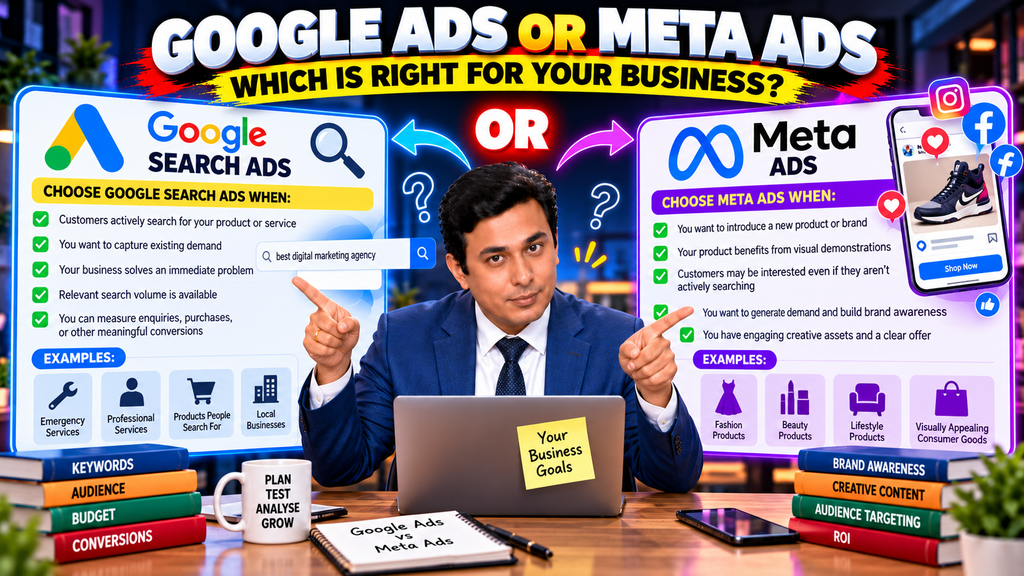
Choose Google Search Ads When:
- Customers actively search for your product or service.
- You want to capture existing demand.
- Your business solves an immediate problem.
- Relevant search volume is available.
- You can measure enquiries, purchases, or other meaningful conversions.
Examples include emergency services, professional services, and products people commonly search for before buying.
Choose Meta Ads When:
- You want to introduce a new product or brand.
- Your product benefits from visual demonstrations.
- Customers may be interested even if they aren’t actively searching.
- You want to generate demand and build brand awareness.
- You have engaging creative assets and a clear offer.
Examples include fashion, beauty products, lifestyle products, and visually appealing consumer goods.
When Should You Use Both?
Many businesses benefit from using both platforms.
For example, a company launching a new skincare product could use Meta Ads to introduce the product and build awareness. Google Search Ads could then capture people searching for the brand, product category, or relevant solutions.
Remarketing and other follow-up activities may also help reconnect with interested customers, subject to platform policies and applicable privacy requirements.
The exact mix should depend on your budget, sales cycle, market demand, and performance data.
Conclusion: Focus on Profitable Conversions, Not Just Conversion Volume
Google Ads and Meta Ads serve different purposes, although their capabilities overlap.
Google Search Ads can be particularly effective when customers are actively looking for a solution. Meta Ads can help businesses introduce products to relevant audiences and generate demand before customers begin searching.
But neither platform guarantees better conversion rates, more sales, or higher ROAS.
A successful campaign requires the right objective, accurate tracking, relevant messaging, an appropriate landing page, and continuous evaluation of business results.
Start by understanding your customer journey. If customers already search for your product, test Google Search Ads. If your product needs discovery and demonstration, consider Meta Ads. If both channels support different stages of your customer journey, test a combination.
Then compare their performance using qualified leads, customer acquisition cost, revenue, and profit—not clicks or conversion volume alone.
Ultimately, the best advertising platform isn’t the one that generates the most conversions. It’s the one that helps you acquire the right customers profitably and grow your business sustainably.
Frequently Asked Questions
1. Is Google Ads better than Meta Ads?
Neither platform is universally better. Google Search Ads can capture existing search demand, while Meta Ads can help businesses reach relevant audiences and generate interest. The right choice depends on your product, audience, sales cycle, and objectives.
2. Which platform is better for conversions?
Both can generate conversions. Google Search Ads may perform well when people actively search for a solution, while Meta Ads may perform well for products that benefit from audience discovery and visual promotion. Compare cost per qualified conversion and customer acquisition cost to determine which works better for your business.
3. Why can Meta Ads generate more conversions than Google Ads?
Meta Ads can reach audiences beyond those actively searching for a product, potentially expanding the number of people who discover and purchase it. However, more conversions do not necessarily mean more profitable conversions.
4. Are exact match keywords better for Google Ads?
Exact match offers more restrictive targeting than phrase or broad match, but it doesn’t guarantee better results. Evaluate match types using conversion quality, cost per acquisition, search-term relevance, and business profitability.
5. Do Google Ads and Meta Ads perform poorly during the learning phase?
Performance can fluctuate while automated systems gather data and adjust delivery. However, the learning phase doesn’t automatically mean poor performance. Results depend on campaign setup, available data, budget, and the conversion objective.
6. Can I run Google Ads and Meta Ads together?
Yes. Businesses can use Google Ads to capture active search demand and Meta Ads to build awareness, introduce products, or reconnect with interested audiences. Using both is worthwhile when their combined contribution justifies the cost.

Related Posts