
Uses your browser’s reading voice.
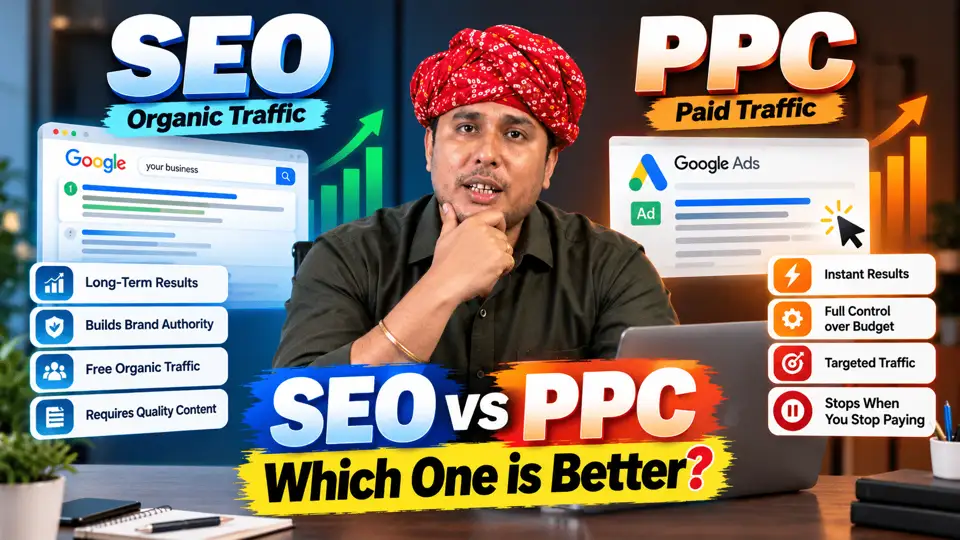
When it comes to digital marketing, one question I frequently come across is: SEO vs PPC—which one is better for growing a business?
My answer is simple: Why choose only one?
With more than 15 years of experience in digital marketing, I believe SEO and Pay-Per-Click (PPC) advertising should not always be treated as competing strategies. Both help businesses reach potential customers, but they work differently, deliver results on different timelines, and require different approaches to investment.
SEO helps you build organic visibility over time, while PPC allows you to pay for targeted advertising placements and generate traffic as your campaigns begin serving.
Think of SEO as rain and PPC as a water hose. Rain can provide water over time, but you cannot control exactly when it arrives. A water hose gives you more control over when and where water flows, but you need a supply to keep it running.
In this article, I will explain the difference between SEO and PPC, their advantages and limitations, practical business examples, and how to combine both strategies for better digital marketing results.
What Is SEO (Search Engine Optimization)?
Search Engine Optimization (SEO) is the process of improving a website’s visibility in organic search engine results.
The objective is to help search engines understand your website and connect your content with people searching for relevant information, products, or services.
For example, suppose you run a digital marketing agency in Bikaner. A potential customer searches Google for “digital marketing agency in Bikaner.”
If your website has relevant service pages, useful content, good technical foundations, and credible authority signals, it may appear in the organic search results.
Unlike paid advertising, you do not pay Google for every click on an organic search result. However, SEO still requires investment in content creation, technical improvements, expertise, and ongoing optimization.
The Main Components of SEO
1. On-page SEO
On-page SEO involves optimizing the content and elements of individual web pages. This includes page titles, headings, internal links, relevant keywords, image alt text, and content quality.
For example, a page targeting “SEO services in Bikaner” should clearly explain the services offered, the intended customers, the approach, and relevant evidence of expertise.
2. Technical SEO
Technical SEO helps search engines crawl, understand, and index your website. Important areas include website architecture, page indexing, canonical tags, mobile usability, site performance, and appropriate structured data.
3. Off-page SEO
Off-page SEO includes activities that strengthen your website’s reputation and authority beyond your own pages. Relevant editorial backlinks, genuine industry mentions, and credible business references can support this effort.
4. Content marketing
Useful articles, detailed guides, service pages, case studies, and frequently asked questions help attract relevant visitors and address customer needs at different stages of the buying journey.
Advantages of SEO
- Builds long-term organic visibility.
- Can attract relevant traffic without paying for every organic click.
- Helps establish brand credibility through useful content.
- Supports discovery across multiple customer research stages.
- Can generate ongoing traffic from previously published pages.
Limitations of SEO
SEO does not provide complete control over rankings or traffic. Search algorithms, competition, changing search intent, and website issues can affect performance.
Results can take months to develop, depending on the website, competition, content quality, and starting position. Even well-optimized websites are not guaranteed top rankings.
SEO also requires continuous attention. Publishing an article once does not guarantee that it will remain competitive indefinitely.
What Is PPC (Pay-Per-Click Advertising)?
Pay-Per-Click (PPC) is an advertising model in which advertisers generally pay when someone clicks on their advertisement.
Google Ads is one of the best-known PPC platforms. Other platforms, including Microsoft Advertising and paid social advertising platforms, provide additional ways to reach potential customers.
With PPC, you can create campaigns targeting particular search terms, locations, audiences, devices, and schedules, depending on the platform and campaign type.
For example, a digital marketing institute in Bikaner could run a Google Ads campaign targeting searches related to digital marketing courses in Bikaner.
The advertisement could direct interested users to a landing page containing course details, eligibility information, student testimonials, and an enquiry form.
When the campaign is eligible to serve and receives clicks, the advertiser pays according to the applicable bidding and billing model.
The Main Components of PPC
1. Keyword targeting
Search campaigns can target relevant keywords and use match types and negative keywords to manage which searches may trigger advertisements.
2. Budget and bidding
Advertisers can set campaign budgets and select suitable bidding strategies. Actual spending and results depend on campaign settings, auction conditions, and platform behavior.
3. Ad copy and creative
Compelling, accurate advertisements help communicate the offer and attract relevant users. Ad relevance and landing-page quality also matter.
4. Landing page optimization
A landing page should match the advertisement, answer customer questions, communicate value clearly, and make the next step easy.
5. Conversion tracking
Conversion tracking helps measure actions such as enquiries, purchases, calls, and qualified leads. Accurate tracking is essential for understanding campaign performance.
Advantages of PPC
- Can generate targeted traffic relatively quickly after campaign launch.
- Provides greater control over budgets, targeting, and advertising messages.
- Allows businesses to test offers and landing pages.
- Supports location-specific and time-sensitive promotions.
- Provides measurable data on clicks, advertising costs, and tracked conversions.
Limitations of PPC
PPC requires ongoing advertising expenditure. When campaigns stop running, the paid traffic they generate usually stops as well.
Competition can increase click costs, and a high number of clicks does not automatically translate into sales.
Poor targeting, weak landing pages, inaccurate conversion tracking, and low-quality offers can waste budget. Successful PPC requires regular monitoring and optimization.
SEO vs PPC: Key Differences
Although both strategies help businesses reach potential customers, their operating models differ.
| Factor | SEO | PPC |
| Traffic source | Organic search results | Paid advertising placements |
| Payment model | No payment per organic click; optimization still costs money | Usually pay per click in PPC campaigns |
| Time to results | Often gradual | Can generate traffic soon after launch |
| Budget control | Less direct control over traffic volume | Greater control over advertising spend |
| Visibility | Depends on organic rankings and search features | Depends on campaign eligibility, bids, budget, and auction conditions |
| Long-term value | Content can continue attracting visitors after publication | Traffic generally depends on continued campaign delivery |
| Testing offers | Possible, but organic feedback may take time | Can test messages and offers more quickly |
| Main measurements | Organic clicks, impressions, rankings, conversions | Spend, clicks, cost per click, conversions, cost per acquisition |
Neither channel guarantees profitability. The right choice depends on the business objective, customer acquisition costs, competition, budget, and the time available to achieve results.
SEO vs PPC: The Rain and Water Hose Analogy
I often find that a simple analogy makes this comparison easier to understand.
SEO Is Like Rain
Rain can replenish the ground and support growth over time, but you cannot decide exactly when it will rain or how much water you will receive.
Similarly, SEO can build a steady source of organic traffic, but you cannot dictate your exact Google rankings or control every algorithm change.
The effort you invest in useful content, website improvements, and authority can continue providing value after the initial work is completed. However, that value is not guaranteed to remain constant.
PPC Is Like a Water Hose
A water hose gives you more control over where water flows and when you use it.
Similarly, PPC allows you to manage campaign budgets, select targeting options, change advertising messages, and direct users to specific landing pages.
But the hose needs a continuing water supply. In the same way, paid traffic generally requires ongoing advertising expenditure.
The practical lesson: SEO helps build an organic traffic source, while PPC provides a more directly controllable way to buy targeted traffic. Businesses can benefit from both.
When Should You Choose SEO?
SEO can be a suitable priority when your business wants to develop sustainable organic visibility and reach customers who regularly search for your products or services.
Consider prioritizing SEO when:
- You want to build long-term visibility for important search queries.
- Your customers research solutions before purchasing.
- You can invest in useful content and website improvements.
- Your business operates in a niche where informational content supports customer acquisition.
- You want to reduce dependence on paid advertising over time.
Example: A digital marketing institute could publish detailed guides about SEO, Google Ads, freelancing, and digital marketing careers. These resources can attract relevant visitors, demonstrate expertise, and introduce potential students to its training services.
The key is to connect informational content with relevant service pages and clear next steps rather than publishing articles solely to attract page views.
When Should You Choose PPC?
PPC may be a stronger immediate priority when your business needs to test demand, promote a time-sensitive offer, or reach customers actively searching for a particular service.
Consider prioritizing PPC when:
- You are launching a new product or service.
- You need traffic before your organic visibility develops.
- You want to test a new offer or landing page.
- You have a clear target audience and conversion goal.
- Your business can measure whether advertising generates profitable customers.
Example: Suppose a training institute is opening admissions for a new course. It could run a location-targeted Google Ads campaign directing relevant searches to an admissions landing page.
The institute should measure qualified enquiries, admissions, and acquisition costs—not just clicks.
PPC is not automatically profitable simply because it generates traffic quickly. The offer, audience, competition, and sales process all influence the outcome.
How to Use SEO and PPC Together
In my view, combining SEO and PPC can create a more flexible digital marketing strategy because each channel can support the other’s objectives.
Here are five practical ways to integrate them.
1. Use PPC Data to Inform SEO Content
Paid search campaigns can provide useful information about the search terms, messages, and offers that attract relevant customers.
Analyze actual search-term reports, conversion data, and customer enquiries. Use those insights to identify topics worth addressing through organic content.
For example, if qualified leads consistently come from searches related to local SEO services, consider developing a comprehensive organic landing page around that service.
Remember that paid search data does not guarantee the same results in organic search. It provides evidence to guide further testing.
2. Use SEO to Build Long-Term Visibility
While PPC supports immediate campaign objectives, publish helpful articles and optimize service pages to build organic visibility.
A business might use Google Ads to promote a service while developing educational content that answers customer questions and supports future organic discovery.
This reduces the need to depend entirely on one traffic source.
3. Test Landing Pages Through Paid Campaigns
PPC can help businesses compare different headlines, offers, calls to action, and landing-page experiences.
Once a change produces reliable evidence of improved user engagement or conversion performance, you can consider applying relevant lessons to organic landing pages.
Be careful to account for differences in audience intent and traffic sources when interpreting results.
4. Coordinate Paid and Organic Search Coverage
Review your paid search terms alongside organic search performance.
If your website already receives strong organic visibility for a query, assess whether paid advertising provides additional value. For high-intent searches, competitors, commercial objectives, and the incremental effect of advertising all matter.
Do not assume that running ads alongside organic results is always necessary—or that ranking organically means you should always stop advertising. Test the economics of the decision.
5. Measure the Entire Customer Journey
Customers may interact with several marketing channels before converting.
Use analytics and reliable conversion tracking to understand how organic search, paid search, direct visits, and other channels contribute to enquiries and sales.
Avoid treating every conversion as the result of the last click alone. Attribution reports are useful, but they do not always prove which channel caused a sale.
How to Measure SEO and PPC ROI
To make informed decisions, evaluate both channels against business outcomes.
For SEO, monitor organic impressions, clicks, relevant rankings, leads, sales, and the cost of producing and maintaining content.
For PPC, monitor advertising expenditure, qualified leads, conversion rate, cost per acquisition, and revenue or profit where reliable tracking is available.
Two useful formulas are:
Cost per acquisition (CPA)
CPA = Total campaign cost ÷ Number of acquisitions
Return on ad spend (ROAS)
ROAS = Revenue attributed to advertising ÷ Advertising spend
For example, if a campaign spends ₹20,000 and generates ₹80,000 in attributed revenue, its ROAS is 4x.
However, a 4x ROAS does not necessarily mean the campaign is profitable. Product costs, salaries, operating expenses, returns, and other costs must also be considered.
For SEO, use a consistent measurement period and account for content production, technical work, and other relevant costs. Organic traffic can fluctuate, so evaluate performance over an appropriate period rather than drawing conclusions from a few days of data.
Final Verdict: SEO or PPC?
After more than 15 years in digital marketing, my recommendation is to stop treating SEO and PPC as an either-or decision.
SEO can help your business develop organic visibility, attract relevant visitors, and build a valuable content asset over time. PPC can help you reach targeted audiences, test offers, and generate traffic when your campaigns are delivering.
Each has costs, limitations, and opportunities.
If your budget is limited, prioritize the activities most closely connected to your business goals. Build a strong website, publish useful content, and use paid campaigns selectively when the expected business value justifies the expense.
If your budget allows, coordinate both channels, measure their individual and combined contributions, and adjust your investment based on evidence.
SEO brings organic visibility. PPC provides paid reach and targeting control. Together, they can help build a more balanced digital marketing strategy.
Instead of asking, “Which one is better—SEO or PPC?” ask a more useful question:
“How can I use SEO and PPC together to attract the right customers and grow my business profitably?”