
Uses your browser’s reading voice.
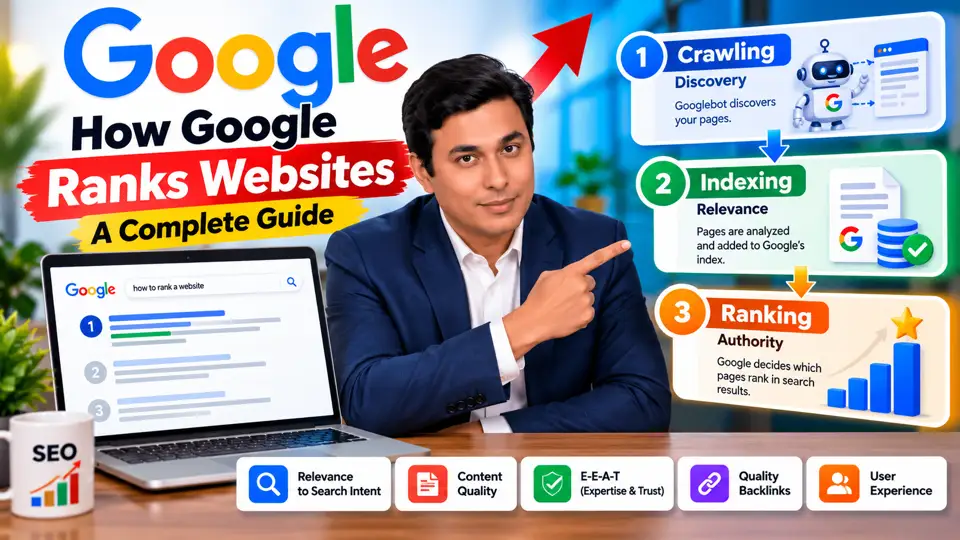
Have you ever wondered why one website appears at the top of Google while another website targeting the same keyword remains on page five? The answer is not simply about adding keywords, publishing long articles, or building hundreds of backlinks.
Google uses automated systems to discover web pages, understand their content, evaluate their relevance, and rank them in response to users’ searches. These systems consider numerous signals to identify content that is helpful, reliable, and relevant to a particular search query.
Understanding how Google ranks websites can help businesses, bloggers, and digital marketers develop a more effective SEO strategy.
In this guide, we will explore how Google Search works, the major factors that influence organic rankings, and the practical steps you can take to improve your website’s visibility.
How Does Google Rank Websites?
Google generally follows three fundamental processes: crawling, indexing, and serving ranked search results.
- Crawling: Google discovers and fetches web pages.
- Indexing: Google analyzes and stores information about eligible pages in its search index.
- Ranking: Google's automated systems select and order relevant results for a user's search.
These processes are connected, but they are not the same. A page can be crawled without being indexed, and an indexed page is not guaranteed to rank prominently.
1. Crawling: How Google Discovers Your Website
Crawling is the process through which Googlebot, Google's web crawler, discovers URLs and retrieves their content.
Google can discover pages through links from other pages, previously known URLs, and XML sitemaps submitted by website owners. Once discovered, Googlebot may crawl a URL to collect information about its content.
For example, imagine you publish a blog titled "How to Do Keyword Research for SEO." Google might discover the page through an internal link from another article or through your XML sitemap.
However, discovery does not guarantee immediate crawling. Google determines which URLs to crawl and how frequently to revisit them based on factors such as availability, crawl capacity, and its assessment of the site's needs.
How to Help Google Crawl Your Website
- Create a logical internal linking structure.
- Submit an accurate XML sitemap through Google Search Console.
- Keep important pages accessible to search engine crawlers.
- Fix broken internal links and unnecessary redirect chains.
- Check your robots.txt file to ensure important content is not accidentally blocked.
- Improve server reliability and page response times.
Practical tip: Use the URL Inspection tool in Google Search Console to check how Google sees a specific URL and whether the page has been indexed.
2. Indexing: How Google Understands Your Content
After crawling a page, Google may analyze its content and other available information to determine whether it should be included in its search index.
This process is known as indexing. Google attempts to understand the page's main topic, language, text, images, links, and other relevant information.
For example, if your page explains "Google Ads for beginners," Google may identify concepts related to paid search, campaign setup, keyword targeting, bidding, and advertising budgets.
Indexing is not simply a process of matching exact keywords. Google's systems use various methods to understand the meaning and context of content.
What Can Affect Indexing?
Several issues may prevent a page from being indexed or make indexing less likely:
- A
noindexdirective tells search engines not to index the page. - A robots.txt rule may prevent Googlebot from crawling the page.
- Duplicate or substantially similar content may influence which URL Google selects as canonical.
- Weak internal linking may make important pages harder to discover.
- Server errors or inaccessible content may prevent successful processing.
- A page may not meet Google's indexing criteria.
It is important to understand that blocking crawling and preventing indexing are different. For example, if a page is blocked by robots.txt, Google may be unable to read a noindex directive placed on that page.
Practical tip: Review the Pages report in Google Search Console to identify indexing issues and prioritize the pages that matter most to your business.
3. Ranking: How Google Selects Search Results
Once Google has information about eligible pages, its automated ranking systems evaluate which results are most useful for a particular search.
The same website may rank differently for different queries because each query expresses a different need.
For example, someone searching for "best digital marketing tools" probably wants comparisons and recommendations. Someone searching for "how to install Google Analytics" needs step-by-step instructions.
A page that satisfies the second search may not be the best result for the first, even if both pages discuss digital marketing.
Google uses multiple signals and systems to assess relevance, usefulness, quality, and other characteristics. No single factor guarantees a top position.
8 Important Factors That Influence Google Rankings
1. Relevance to Search Intent
Relevance is fundamental to organic search visibility. Google aims to present results that address the user's query and underlying need.
Search intent is the reason behind a search. Common categories include:
- Informational: The user wants to learn something.
- Navigational: The user wants to reach a particular website or page.
- Commercial investigation: The user is comparing products or services.
- Transactional: The user wants to complete an action, such as making a purchase.
For example, a search for "Ahrefs vs Semrush" suggests that the user wants a comparison. A detailed comparison article is likely a better fit than a generic introduction to SEO.
How to improve relevance: Study the search results for your target keyword, understand what users expect, and create content that answers their questions clearly.
2. Content Quality and Usefulness
Publishing content is not enough. Your page should provide meaningful information that helps readers accomplish their goals.
Useful content typically has a clear purpose, accurate information, practical explanations, and sufficient detail for the topic.
For example, an article about reducing Google Ads costs becomes more valuable when it includes realistic campaign examples, budget considerations, common mistakes, and actionable recommendations.
To improve content quality:
- Answer the main question early.
- Organize information using descriptive headings.
- Include relevant examples and original insights.
- Verify facts and update outdated information.
- Remove repetitive paragraphs that add little value.
- Make the content easy to understand and navigate.
Longer content does not automatically rank higher. A concise page that fully satisfies a user's need may be more useful than a lengthy article filled with repetition.
3. Experience, Expertise, Authoritativeness, and Trustworthiness (E-E-A-T)
E-E-A-T stands for Experience, Expertise, Authoritativeness, and Trustworthiness. Google uses these concepts in its Search Quality Rater Guidelines to describe characteristics associated with high-quality content.
E-E-A-T is not a single direct ranking factor or a score that website owners can switch on. Rather, Google's systems use a variety of signals that can help identify content demonstrating relevant qualities.
You can strengthen your website's credibility by:
- Publishing accurate, well-researched information.
- Including genuine practical experience where relevant.
- Identifying authors and explaining their qualifications when appropriate.
- Citing reliable sources for factual claims.
- Maintaining clear contact information and business details.
- Correcting errors and keeping important information current.
Trust is particularly important for topics involving health, financial decisions, safety, and other areas that can significantly affect people's lives.
4. Quality Backlinks
Backlinks are links from other websites pointing to your pages. They can help Google discover content and provide signals about a page's importance and relevance.
However, not all backlinks offer the same value. Links that arise naturally from relevant, trustworthy websites are generally more desirable than links created primarily to manipulate rankings.
For example, a detailed marketing guide cited by a respected industry publication may attract relevant visitors and provide a useful reference for readers.
To build a sustainable backlink profile:
- Publish original research, useful resources, or detailed guides.
- Build genuine relationships with relevant publishers.
- Contribute expert insights to appropriate industry publications.
- Promote content to people who may genuinely find it useful.
- Avoid buying links intended to manipulate search rankings.
The objective should be to earn meaningful references, not simply to increase the number of backlinks.
5. Technical SEO and Website Accessibility
Technical SEO helps search engines access, process, and understand your website.
Even excellent content can struggle to perform if important pages are inaccessible, incorrectly canonicalized, or affected by technical errors.
Important technical SEO practices include:
- Using descriptive, consistent URLs.
- Implementing appropriate canonical tags.
- Maintaining a clear internal linking structure.
- Fixing important crawl and server errors.
- Using HTTPS.
- Providing descriptive page titles and useful meta descriptions.
- Applying structured data when it accurately represents the page's content.
Remember that technical SEO creates a strong foundation, but fixing every technical issue does not guarantee high rankings.
6. Page Experience and Core Web Vitals
Users should be able to access and navigate your website comfortably across devices.
Google's Core Web Vitals measure aspects of real-world user experience:
- Largest Contentful Paint (LCP): Measures loading performance.
- Interaction to Next Paint (INP): Measures responsiveness to user interactions.
- Cumulative Layout Shift (CLS): Measures visual stability.
Good Core Web Vitals are beneficial for users, but they do not guarantee higher rankings. Relevance and overall usefulness remain essential.
Improve page experience by optimizing images, reducing unnecessary scripts, improving server performance, using responsive layouts, and preventing unexpected layout shifts.
7. Freshness and Content Updates
Freshness matters more for some searches than others.
For example, a query about current Google Ads features may require recent information. A query about the definition of a backlink may not require frequent updates.
Review your content periodically and update it when facts, tools, regulations, examples, or user expectations change.
Do not change publication dates or rewrite articles merely to make them appear fresh. Updates should provide genuine value.
8. Keywords and On-Page SEO
Keywords help communicate a page's topic, but effective on-page SEO goes beyond repeating an exact phrase.
Use your primary keyword naturally in relevant locations, such as the title, main heading, introduction, and URL when appropriate. Include related terminology where it helps explain the topic.
Also pay attention to:
- Descriptive title tags.
- Clear heading hierarchy.
- Relevant internal links.
- Descriptive image alt text.
- Useful meta descriptions.
- Content that answers related questions naturally.
Avoid keyword stuffing. Repeating a keyword excessively can make content difficult to read and does not guarantee improved rankings.
Does Google Use Click-Through Rate and Dwell Time as Ranking Factors?
It is common to hear that pages rank higher simply because users click them more often or spend longer on them. This is an oversimplification.
Google uses many signals and systems, and its ranking documentation does not establish a simple rule that a high organic click-through rate or longer dwell time directly improves rankings.
Click-through rate can be useful for diagnosing how well your search listing attracts relevant visitors. Engagement metrics can help you understand whether people find your website useful. However, these metrics should not be treated as guaranteed ranking levers.
Focus on satisfying search intent, presenting accurate titles and descriptions, and providing a positive user experience.
How Many Ranking Factors Does Google Use?
You may encounter claims that Google uses exactly 200 ranking factors. This figure is often repeated in SEO discussions, but it should not be treated as a verified, fixed checklist.
Google uses many signals and automated systems, and their importance can vary depending on the query, content, and context. The systems also evolve over time.
There is no reliable formula that tells every website owner exactly how much each signal contributes to every search result.
Instead of chasing a supposed list of 200 factors, focus on fundamentals: useful content, clear relevance, technical accessibility, credible information, and a website experience that serves your audience.
How to Improve Your Website's Google Rankings
Use this practical checklist to strengthen your SEO strategy:
- Research search intent: Understand what users expect when they enter your target query.
- Create helpful content: Provide accurate answers, original insights, and useful examples.
- Improve on-page SEO: Write descriptive titles, headings, URLs, and internal links.
- Fix technical issues: Check crawling, indexing, canonicalization, and server errors.
- Build credibility: Demonstrate relevant experience and support important claims with reliable sources.
- Earn relevant backlinks: Create resources worth referencing and promote them responsibly.
- Improve page experience: Make your website responsive, fast, accessible, and easy to navigate.
- Measure performance: Use Google Search Console to monitor impressions, clicks, queries, indexing, and page performance.
- Update content when needed: Keep information accurate and useful as the subject evolves.
SEO is an ongoing process. A page may take time to be discovered, indexed, and evaluated, and rankings can change as search results and competing content evolve.
Frequently Asked Questions
1. What are the three main stages of Google Search?
The three main processes are crawling, indexing, and serving ranked search results. Crawling discovers and retrieves pages, indexing analyzes and stores information about eligible pages, and ranking systems select and order relevant results for a query.
2. What is the most important Google ranking factor?
There is no single ranking factor that guarantees success for every query. Relevance, content usefulness, quality, links, technical accessibility, and other signals can contribute to performance depending on the search.
3. Does publishing more content improve rankings?
Not automatically. Publishing useful, original content that meets audience needs is more valuable than producing large quantities of repetitive or low-value articles.
4. Do backlinks still matter for SEO?
Backlinks can help Google discover pages and can contribute to assessments of a page's importance and relevance. The goal should be to earn relevant, credible links naturally rather than manipulate link counts.
5. Can a new website rank on Google?
Yes. New websites can rank when their pages are relevant and useful for a query. However, visibility depends on factors such as competition, content quality, technical accessibility, and how well the website meets users' needs.
6. How long does Google take to rank a website?
There is no guaranteed timeline. Crawling, indexing, and ranking changes can take varying amounts of time, and a page may never achieve the position its owner expects. Monitor results and improve your content based on evidence.
Conclusion
Google ranks websites by using automated systems to understand search queries and identify pages that are relevant and useful to users. Crawling and indexing make content available for consideration, while ranking systems determine how eligible pages appear in search results.
For sustainable SEO growth, prioritize helpful content, search intent, technical accessibility, credible information, relevant backlinks, and a positive user experience.
Rather than chasing secret ranking formulas or outdated lists of ranking factors, build a website that deserves to be found and provides genuine value to its audience.
The key takeaway: SEO is not about manipulating one signal. It is about helping search engines understand your pages and helping people find the information they need.