
Uses your browser’s reading voice.
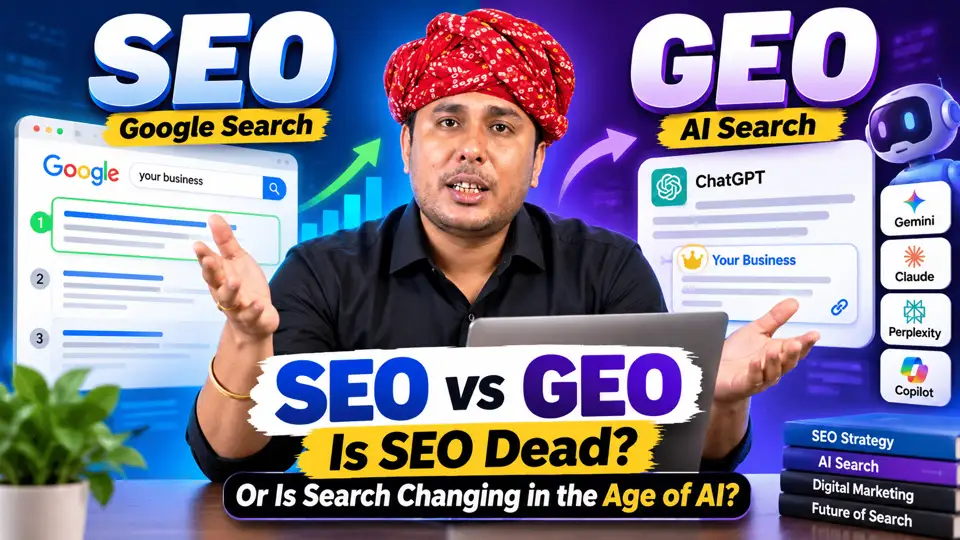
SEO is not dead. Search is changing. For years, businesses have focused on ranking higher on Google, attracting organic traffic, and converting visitors into customers. Today, however, people are also turning to AI-powered tools such as ChatGPT, Google Gemini, Perplexity, Claude, and Microsoft Copilot to discover information, compare products, and find businesses.
This shift has introduced a new concept into digital marketing: Generative Engine Optimization (GEO).
As a digital marketing professional with more than 15 years of experience, I believe businesses should not treat GEO as a replacement for SEO. Instead, they should understand how both approaches work together to improve online visibility, establish brand authority, and reach potential customers.
The goal is no longer just to appear in traditional search results. Businesses also need to become credible sources that AI-powered search experiences can discover, understand, and potentially recommend.
Let’s explore the differences between SEO and GEO, why this shift matters, and how businesses can adapt their digital marketing strategies.
What Is SEO (Search Engine Optimization)?
Search Engine Optimization (SEO) is the process of improving a website’s visibility in organic search engine results. It involves optimizing website content, technical performance, internal linking, user experience, and external authority to help search engines understand and rank relevant pages.
For example, imagine you own a digital marketing institute in Bikaner. When someone searches for “best digital marketing institute in Bikaner,” you want your website to appear among the relevant organic results.
To improve your chances, you might:
- Publish useful pages about your courses, training approach, and student projects.
- Optimize page titles, headings, URLs, and relevant keywords.
- Improve website speed and mobile usability.
- Build relevant, trustworthy backlinks.
- Strengthen your Google Business Profile and local search presence.
- Track organic impressions, clicks, rankings, and conversions.
Traditional SEO helps connect your website with people who are actively searching for information, products, services, or solutions.
However, search behavior is evolving. People are increasingly asking complete questions and expecting direct, conversational answers rather than browsing multiple websites individually.
What Is GEO (Generative Engine Optimization)?
Generative Engine Optimization, or GEO, refers to strategies intended to improve a brand’s visibility within answers generated by AI-powered search and conversational systems.
Instead of focusing exclusively on traditional search rankings, GEO aims to make a business, its expertise, and its content easier for AI systems to discover, interpret, and potentially reference in relevant answers.
Consider a user asking ChatGPT:
“Which digital marketing institute in Bikaner offers practical training and freelancing guidance?”
An AI-generated answer may discuss different institutes, summarize their offerings, and provide links to relevant websites. If your business has clear, accurate, useful information available online, it may have a better opportunity to be considered and referenced.
However, GEO does not guarantee that an AI tool will recommend your brand. AI-generated answers vary depending on the platform, question, available sources, and other factors.
GEO can involve several activities:
- Publishing original, expert-led content.
- Building a recognizable and trustworthy brand.
- Maintaining accurate business information across relevant websites.
- Earning genuine mentions and references from credible sources.
- Organizing content so important information is easy to understand.
- Ensuring relevant website pages are accessible to search and AI retrieval systems.
- Monitoring whether your brand appears in relevant AI-generated responses.
The objective is to improve your chances of being discovered and represented accurately in AI-driven information experiences.
SEO vs GEO: What Is the Difference?
SEO and GEO share the broader objective of increasing online visibility, but they focus on different discovery experiences.
| Factor | Traditional SEO | GEO |
| Primary objective | Improve visibility in organic search results | Improve visibility in AI-generated answers |
| Discovery experience | Users browse search results | Users receive synthesized answers |
| Content priority | Relevant, useful, search-focused content | Relevant content that is clear, useful, and suitable for AI retrieval |
| Authority signals | Relevant backlinks, reputation, content quality, and other ranking signals | Credible sources, consistent brand information, useful content, and platform-specific retrieval signals |
| Common measurements | Impressions, clicks, rankings, organic conversions | Brand mentions, citations, linked references, referral visits, and assisted conversions |
| Technical foundation | Crawlability, indexability, site structure, and performance | Many of the same foundations, plus access to relevant AI retrieval systems |
| Business outcome | Organic discovery, website visits, and conversions | AI-assisted discovery, brand consideration, referral traffic, and conversions |
These distinctions are useful, but they should not be interpreted as completely separate sets of rules. Google’s guidance confirms that its AI search experiences continue to rely on foundational SEO practices. GEO is best understood as an additional visibility objective, not an entirely independent discipline.
How User Behavior Is Changing in the Age of AI
One of the biggest changes in digital discovery is the way people formulate questions.
Previously, a person might search Google for:
“Best CRM software”
They would then compare websites, product pages, reviews, and pricing information.
Today, that same person might ask an AI tool:
“Compare three CRM platforms for a small business with five employees, limited budget, and a need for WhatsApp integration.”
The AI system may provide a summarized comparison, explain trade-offs, and reference selected sources.
This changes the discovery journey in three important ways.
1. Users Can Discover Brands Without Visiting Their Websites First
An AI-generated answer may introduce a company before the user visits its website. The user can become familiar with the brand during the research process itself.
This creates an opportunity to build awareness even when the initial interaction does not generate a click.
2. Brand Mentions and Citations Become Important Visibility Signals
When an AI response mentions a business or links to its website, that exposure may influence whether the user considers it.
However, a mention is not automatically an endorsement, and a citation does not guarantee a sale. Businesses should evaluate whether the visibility reaches the right audience and contributes to meaningful outcomes.
3. Search Journeys May Involve Multiple Platforms
A potential customer might discover a business through Google, read reviews, ask ChatGPT for a comparison, watch a YouTube video, and finally visit the company’s website.
This means marketers should look beyond a single keyword ranking and understand how different discovery channels contribute to the overall customer journey.
Why SEO Is Still Important for GEO
A common misconception is that businesses must abandon traditional SEO to succeed in AI search. That is not a sound strategy.
Google’s official documentation explains that its AI search features continue to use foundational search and content-quality practices. Similarly, ChatGPT search depends on systems that discover and retrieve relevant web content.
This creates several areas where SEO and GEO overlap.
1. Crawlability and Indexability
Search systems cannot reliably use content they cannot access. Important pages should be crawlable, indexable where appropriate, and accessible without unnecessary technical barriers.
Review your robots.txt file, canonical tags, internal links, server responses, and indexing status. If visibility in ChatGPT search matters to your business, also review OpenAI’s published crawler guidance and check whether OAI-SearchBot is blocked.
Allowing a crawler does not guarantee inclusion, but accidentally blocking relevant content can limit discovery opportunities.
2. High-Quality, Helpful Content
Search engines and AI-powered systems need useful information to answer questions accurately.
A page that merely repeats generic definitions offers little reason for users to prefer it over hundreds of similar pages.
Instead, publish content that includes practical examples, original observations, clear explanations, relevant evidence, and answers to real customer questions.
For example, rather than writing only “What is SEO?”, explain how a local business can improve its visibility, which measurements matter, what mistakes to avoid, and how to evaluate results.
3. Strong Brand Authority
A recognizable brand with a consistent online presence is easier for customers to research and evaluate.
Develop authority through relevant industry contributions, genuine customer reviews, original case studies, expert commentary, and useful resources. Keep business details consistent across your website and important third-party profiles.
Do not purchase irrelevant mentions or create artificial brand references simply to influence AI systems. Focus on earning recognition through real expertise and useful contributions.
4. Clear Website Structure
Use descriptive headings, meaningful page titles, logical internal links, concise definitions, and well-organized sections.
These practices help people navigate your content and make important information easier for search systems to interpret.
Structured data can also help search engines understand eligible content when implemented correctly. However, there is no special schema markup that guarantees a brand will appear in AI-generated answers.
5. Original Information and First-Hand Experience
Your experience can be a competitive advantage when it produces genuinely useful information.
Share real project observations, explain the reasoning behind your recommendations, document methods, and use examples that demonstrate practical knowledge.
Do not invent results, client testimonials, awards, or performance figures. Credibility grows when your claims are transparent and supported by evidence.