
Uses your browser’s reading voice.
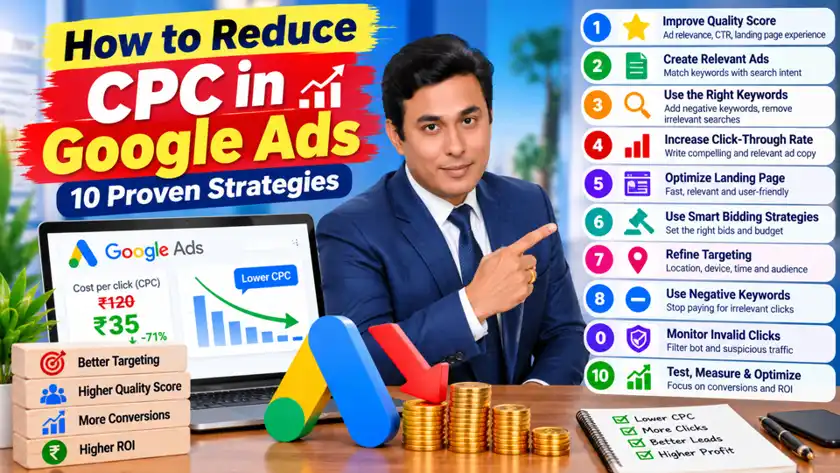
Are you spending too much on Google Ads clicks without generating enough leads or sales? High cost per click (CPC) can quickly consume your advertising budget, especially in competitive industries such as insurance, finance, real estate, and legal services.
However, reducing CPC is not simply about lowering your bids. Your costs may be influenced by keyword competition, ad relevance, Quality Score, bidding strategy, audience targeting, and landing page performance.
More importantly, cheap clicks do not automatically mean profitable advertising. Paying ₹20 per click for visitors who never convert may be worse than paying ₹100 per click for visitors who become valuable customers.
The real objective is to reduce wasted ad spend while maintaining or improving conversions and profitability.
In this guide, you will learn 10 practical ways to reduce CPC in Google Ads and improve the overall return on your advertising investment.
What Is CPC in Google Ads?
Cost per click (CPC) is the amount you pay when someone clicks your advertisement.
The average CPC is calculated by dividing the total cost of your clicks by the number of clicks received.
Formula:
Average CPC = Total advertising cost ÷ Total clicks
For example, suppose your Google Ads campaign spends ₹10,000 and generates 200 clicks.
Average CPC = ₹10,000 ÷ 200 = ₹50
Your average cost per click is ₹50.
However, CPC alone does not tell you whether the campaign is successful. You must also evaluate conversion rate, cost per lead, cost per acquisition, and the revenue or profit generated from those clicks.
Why Is Your Google Ads CPC So High?
Before trying to reduce CPC, identify what is causing it.
Common reasons include:
- High competition for valuable keywords.
- Poor alignment between search terms, ads, and landing pages.
- Low expected click-through rate.
- Aggressive bidding settings.
- Broad targeting that attracts irrelevant visitors.
- Weak landing page experience.
- Search queries that do not match your business offering.
- Competition for particular locations, devices, or times.
- Invalid or automated clicks that require investigation.
Not every high-CPC campaign has a problem. Competitive keywords can be expensive because advertisers expect those clicks to generate valuable customers.
Start by reviewing your campaign data rather than automatically reducing every bid.
10 Ways to Reduce CPC in Google Ads
1. Improve Your Quality Score
Quality Score is Google's diagnostic rating for eligible Search keywords, reported on a scale of 1 to 10. It helps advertisers understand how their ads compare with Google's expectations for relevance and user experience.
Google uses three main components in the Quality Score diagnostic:
- Expected click-through rate.
- Ad relevance.
- Landing page experience.
Quality Score is not a direct summary of every auction-time factor, and it is not itself a universal formula for determining your CPC. However, improving the underlying factors can help your ads compete more effectively.
How to improve Quality Score
Improve expected CTR: Write relevant, compelling ads that communicate a clear benefit and match the user's search.
Improve ad relevance: Make sure the ad closely relates to the keywords and search intent you are targeting.
Improve landing page experience: Ensure the destination is relevant, easy to navigate, mobile-friendly, and useful to visitors.
For example, if someone searches for "digital marketing course in Bikaner," an ad leading to a relevant course page is generally more appropriate than an ad leading to a generic homepage.
The objective is to make the entire journey—from search query to advertisement to landing page—consistent.
2. Improve Ad Relevance and Account Structure
A poorly structured Google Ads account can show the wrong advertisement for a search query.
Imagine an advertiser offering SEO services, social media marketing, and Google Ads management. If all these services are grouped into a single, overly broad ad group, it may be difficult to create highly relevant ads for every search.
Instead, organize campaigns and ad groups around closely related services, keywords, and user needs.
For example:
- SEO Services
- Google Ads Management
- Social Media Marketing
- Website Development
Write ads that communicate the benefits relevant to each group.
A Google Ads campaign with a logical structure makes it easier to manage budgets, analyze performance, and align advertisements with search intent.
Avoid creating excessive numbers of ad groups without a clear purpose. The goal is meaningful relevance, not complexity for its own sake.
3. Research Keywords and Remove Irrelevant Search Terms
Your keyword strategy has a direct impact on the traffic your campaigns attract.
If your ads appear for searches that are unrelated to your offering, you may pay for clicks that have little chance of converting.
For example, a company offering paid digital marketing training might want to target searches such as "digital marketing course with practical training." Depending on its offering, it may want to exclude irrelevant searches related to free-only resources, unrelated jobs, or other services it does not provide.
Review the Search terms report in Google Ads to understand the actual queries triggering your ads.
Then consider:
- Adding relevant negative keywords.
- Separating different services into suitable campaigns.
- Using appropriate keyword match types.
- Identifying expensive queries with poor conversion performance.
- Testing more specific keywords when they better match your offer.
Do not automatically exclude a search term simply because it has a high CPC. If it consistently generates profitable customers, it may be worth retaining.
4. Improve Your Click-Through Rate (CTR)
Click-through rate (CTR) is the percentage of impressions that result in clicks.
Formula:
CTR = (Clicks ÷ Impressions) × 100
For example, if your ad receives 1,000 impressions and 50 clicks, your CTR is 5%.
A strong CTR can indicate that your ads are relevant and appealing to the audience seeing them. Expected CTR is also one of the components used in Quality Score diagnostics.
However, increasing CTR does not automatically reduce CPC. The effect depends on the auction, competition, ad quality, and other factors.
Ways to improve CTR
- Write specific, benefit-focused headlines.
- Align ad copy with the search query.
- Explain what differentiates your product or service.
- Use relevant responsive search ad assets.
- Include a clear call to action.
- Test different messages and value propositions.
- Avoid attracting clicks from people who are unlikely to become customers.
For example, instead of a generic headline such as "Digital Marketing Services," a business might test a more specific message such as "Digital Marketing for Local Businesses."
Only use claims and benefits that your business can genuinely deliver.
5. Optimize Your Landing Page Experience
Your advertisement may attract the right visitor, but a weak landing page can waste the click.
A landing page should deliver what the ad promises and make the next step easy to complete.
Suppose someone clicks an ad for Google Ads management services. If the landing page discusses unrelated services, takes too long to load, or hides the enquiry form, the visitor may leave without converting.
Improve your landing page by:
- Matching its headline to the ad's main message.
- Explaining the service or product clearly.
- Making the primary call to action easy to find.
- Improving mobile usability and loading performance.
- Removing unnecessary form fields.
- Providing accurate pricing or service details where appropriate.
- Adding relevant trust signals and genuine testimonials.
- Ensuring that forms and conversion tracking work correctly.
Google's landing page experience assessment considers factors such as relevance, usefulness, transparency, and ease of navigation. Do not rely on a single engagement metric, such as bounce rate or time on page, as a complete measure of landing page quality.
A better landing page can improve conversion performance and, where it improves Google's landing page experience assessment, may also support better ad quality.
6. Review Your Bidding Strategy
Your bidding strategy affects how Google participates in advertising auctions on your behalf.
Depending on your campaign objectives and data, you might use manual CPC bidding where available, Maximize Clicks, Maximize Conversions, Target CPA, or another suitable strategy.
Each approach has different objectives and trade-offs.
Manual CPC: Offers direct control over eligible keyword or ad group bids in supported campaign types.
Maximize Clicks: Aims to generate as many clicks as possible within your budget, subject to your settings.
Maximize Conversions: Uses automated bidding to seek conversions within your budget.
Target CPA: Attempts to generate conversions around a specified average acquisition cost when supported and suitable for your campaign.
Do not choose a bidding strategy solely because it promises cheaper clicks. For a lead-generation business, a conversion-focused strategy may be more appropriate than maximizing traffic.
Review the strategy, conversion data, budget, and performance history before making changes.
7. Optimize Location, Device, and Schedule Targeting
Not every audience segment performs equally.
Your campaign might receive clicks from different cities, devices, or times of day, with significant differences in conversion rates and customer value.
For example, a local service provider may discover that enquiries from its service area convert more consistently than clicks from distant locations.
Review performance by:
- Geographic location.
- Device type.
- Day of the week.
- Time of day.
- Audience segments, where relevant.
- Conversion rate and cost per conversion.
Use these findings to refine targeting, schedules, and eligible bid adjustments where supported by your campaign type and bidding strategy.
Be careful not to draw conclusions from very small data samples. A segment with a high CPC may still be profitable, while a low-CPC segment may produce no meaningful business results.
8. Use Negative Keywords Strategically
Negative keywords help prevent your ads from showing for searches that are irrelevant to your offering.
For example, a paid training provider may choose to exclude certain searches associated with unrelated free resources or job vacancies if those searches do not align with its business goals.
Negative keywords can reduce wasted spend by filtering out unsuitable traffic. However, they should be selected carefully because overly broad exclusions may prevent relevant customers from seeing your ads.
Review search terms regularly, particularly after launching a new campaign or expanding keyword coverage.
Build negative keyword lists around genuine patterns in irrelevant searches rather than adding exclusions based on assumptions alone.
9. Monitor Invalid Clicks and Potential Click Fraud
Some advertisers worry that bots or invalid clicks are increasing their Google Ads expenses.
Google uses systems to detect and filter invalid activity. Advertisers may see invalid-click adjustments in their reporting or billing, depending on the circumstances.
If you suspect unusual activity, review:
- Sudden unexplained changes in click volume.
- Repeated patterns of suspicious traffic.
- Geographic or device segments with unusual behavior.
- Discrepancies between advertising clicks and analytics sessions.
- Conversion quality and CRM records.
Differences between Google Ads clicks and analytics sessions do not automatically prove click fraud; tracking limitations, consent settings, page loading, and other factors can contribute.
Third-party traffic-quality services may provide additional monitoring or filtering capabilities, but evaluate their evidence, compatibility, and cost before adopting them. They are not a guaranteed way to reduce CPC.
If you identify potentially invalid activity, document the relevant campaign details and use Google's official support or invalid-traffic reporting processes as appropriate.
10. Test, Measure, and Optimize Continuously
Google Ads optimization is an ongoing process. A change that works in one campaign may not work in another.
Use controlled experiments where available, and change settings in a way that helps you understand what caused the result.
Test variables such as:
- Ad headlines and descriptions.
- Landing page messaging.
- Keyword and negative keyword choices.
- Bidding strategies.
- Geographic targeting.
- Calls to action.
Measure more than CPC. Track conversions, cost per lead, cost per acquisition, lead quality, and revenue or profit where possible.
Avoid making large changes based on a handful of clicks. Allow enough time and data for a meaningful evaluation, taking into account your sales cycle and conversion volume.
Should You Always Try to Get the Lowest CPC?
No. This is one of the most important principles in paid advertising.
Consider two hypothetical campaigns:
| Metric | Campaign A | Campaign B |
|---|---|---|
| Average CPC | ₹20 | ₹80 |
| Clicks | 500 | 125 |
| Advertising spend | ₹10,000 | ₹10,000 |
| Conversion rate | 1% | 8% |
| Conversions | 5 | 10 |
| Cost per conversion | ₹2,000 | ₹1,000 |
Campaign A generates cheaper clicks, but Campaign B produces twice as many conversions for the same spend and has a lower cost per conversion.
These are illustrative figures, not industry benchmarks. They demonstrate why CPC must be evaluated alongside conversion performance.
If Campaign B's conversions also generate sufficient revenue and profit, its higher CPC may be entirely justified.
The better question is not simply, "How can I get cheaper clicks?" It is, "How can I generate more valuable results from my advertising budget?"
How to Build a More Profitable Google Ads Campaign
A profitable campaign requires more than keyword selection and bid adjustments.
Start by identifying the search terms your ideal customers use. Create relevant ads that clearly communicate your offering, send visitors to appropriate landing pages, and measure whether those visitors become qualified leads or paying customers.
Then review the entire conversion journey. If clicks are expensive but sales are weak, the underlying issue might be poor targeting, an unclear unique selling proposition, an ineffective landing page, weak follow-up, or an offer that does not meet customer expectations.
Sometimes a lower ad position may deliver better economics, but this should be tested rather than assumed. Similarly, higher CTR is useful only when it attracts relevant visitors and contributes to meaningful results.
Connect Google Ads conversion data with your sales or CRM data whenever practical so you can distinguish low-cost leads from leads that actually become customers.
Frequently Asked Questions
1. What is a good CPC in Google Ads?
There is no universal good CPC. Costs vary by industry, keyword, location, competition, campaign type, and customer value. Evaluate CPC against conversion rate, cost per acquisition, and profitability.
2. Does improving Quality Score reduce CPC?
Improving the factors behind Quality Score can help your ads compete more effectively. However, Quality Score is a diagnostic metric, not a direct pricing formula, and no particular score guarantees a specific CPC.
3. Does a higher CTR always lower CPC?
No. A higher CTR can indicate improved relevance and is related to the expected CTR component of Quality Score. Actual CPC also depends on auction competition, ad quality, bidding, and other factors.
4. Can negative keywords reduce Google Ads costs?
Yes. Negative keywords can prevent ads from appearing for unsuitable searches, helping reduce wasted spend. They should be chosen carefully to avoid excluding relevant potential customers.
5. Should I reduce my bids if my CPC is too high?
Not automatically. First determine whether the traffic generates profitable conversions. If it does not, investigate search terms, targeting, ad relevance, landing page performance, and bidding settings before deciding whether to reduce bids.
Conclusion
Reducing CPC in Google Ads requires a structured approach to campaign optimization. Improve ad relevance, refine keyword targeting, review bidding, strengthen landing pages, manage targeting carefully, and investigate suspicious traffic when necessary.
But remember that the lowest CPC does not always deliver the best results.
The ultimate goal is to make every advertising rupee work harder by attracting relevant visitors, generating qualified leads, and converting those leads into profitable customers.
Start with your campaign data: Identify your most expensive search terms, compare their conversion performance, and prioritize the changes most likely to improve your cost per conversion and overall return on ad spend.