
Uses your browser’s reading voice.
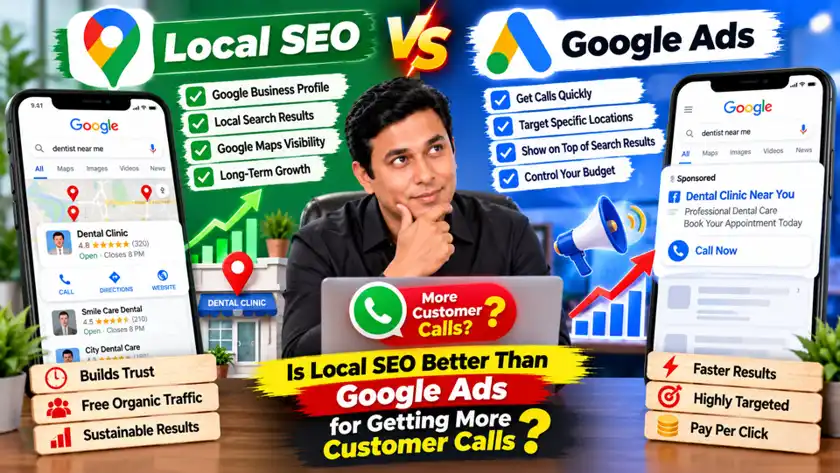
Imagine you own a dental clinic, plumbing service, coaching institute, salon, or another local business. When someone nearby searches Google for the service you offer, you want your business to appear at the right moment—and you want that person to call you.
But which strategy should you invest in: local SEO or Google Ads?
Both can help local businesses attract potential customers, but they work differently. Google Ads can help you gain visibility through paid placements relatively quickly, while local SEO helps improve your visibility in unpaid local search results over time.
The right choice depends on how quickly you need leads, your budget, the competition in your area, and the value of each new customer.
In general, Google Ads is useful when you need to generate enquiries quickly, while local SEO is valuable for building long-term visibility. For many businesses, combining both can be an effective approach.
Let's compare the two strategies and understand how to choose the right one for your business.
What Is Local SEO?
Local SEO, or local search engine optimization, is the process of improving a business's visibility in search results for location-related searches.
For example, someone might search for:
- Dentist near me
- Plumber in Bikaner
- Best coaching institute in my area
- Hair salon near me
- Digital marketing agency in Bikaner
Google may show local business listings, Google Maps results, and relevant website pages for these searches.
Local SEO helps your business become more discoverable when people search for the products or services you provide in your service area.
How does local SEO work?
Local SEO typically involves several activities:
1. Optimize your Google Business Profile
Maintain accurate business information, including your name, address or service area, phone number, business hours, categories, and services.
2. Collect genuine customer reviews
Encourage customers to share honest feedback about their experiences. Respond professionally to reviews and address concerns where appropriate.
3. Improve your website
Create useful service pages that explain what you offer, whom you serve, and which locations you cover.
4. Maintain consistent business information
Ensure your business details are accurate across important directories and platforms where your business is listed.
5. Build local relevance and credibility
Publish useful content, earn relevant links where appropriate, and provide clear information about your services and business.
Local SEO does not guarantee a particular ranking position. Results depend on factors such as relevance, distance, prominence, competition, and the quality of your online presence.
What Are Google Ads?
Google Ads is Google's paid advertising platform. Businesses can use it to show advertisements to people searching for relevant products or services, subject to campaign settings, eligibility, and auction outcomes.
For example, a plumbing business could create a Search campaign targeting relevant plumbing service queries in its service area.
When eligible, its advertisement may appear prominently on the search results page, giving the business an opportunity to attract potential customers.
How do Google Ads work for local businesses?
A typical campaign involves:
- Selecting a campaign objective.
- Choosing relevant keywords or targeting settings.
- Defining suitable locations.
- Writing advertisements.
- Setting a budget and bidding strategy.
- Sending visitors to a relevant website page or providing a suitable call option.
- Tracking calls, leads, and other conversions.
Depending on the campaign setup and available features, you may be able to encourage direct calls or send users to a landing page with a prominent phone number.
Google Ads can start generating visibility soon after a campaign becomes eligible to serve, but actual impressions and calls are not guaranteed. Results depend on demand, competition, budget, targeting, ad quality, and other factors.
Local SEO vs Google Ads: Key Differences
| Factor | Local SEO | Google Ads |
|---|---|---|
| Main approach | Improve unpaid local search visibility | Pay to show eligible advertisements |
| Speed | Usually takes time to build | Can generate visibility relatively quickly |
| Cost model | Ongoing work and resources; no payment for each organic click | Advertising spend, often including payment for clicks or other campaign interactions depending on setup |
| Long-term value | Can build lasting visibility and credibility | Visibility generally depends on continued campaign funding and eligibility |
| Google Maps visibility | Can improve eligibility and local relevance | Ads may appear in eligible local placements, depending on campaign setup |
| Control | Less direct control over rankings | More control over budgets, targeting, and campaign settings |
| Competition | Compete for organic local visibility | Compete in advertising auctions |
| Measurement | Rankings, organic traffic, calls, enquiries | Impressions, clicks, calls, conversions, and cost per result |
| Best suited for | Building sustainable local visibility | Testing demand and seeking faster paid visibility |
Neither strategy is universally better. The right choice depends on your business objectives and the results each channel can deliver.
1. Which Strategy Can Get Customer Calls Faster?
If your immediate priority is to generate phone enquiries, Google Ads may be the more suitable starting point.
Once your campaign is approved, eligible, and serving, you can begin reaching people searching for relevant services without waiting for your website to improve its organic rankings.
For example, an electrician who wants to generate enquiries for repair services can test a local Search campaign targeting relevant service queries.
However, launching a campaign does not guarantee calls. If the keywords are irrelevant, the budget is insufficient for the market, or the offer is unconvincing, results may be limited.
What about local SEO?
Local SEO usually requires more time because your business needs to establish relevant online information and compete with other businesses in local results.
You may need to improve your Google Business Profile, build useful service pages, collect genuine reviews, and strengthen your overall local presence.
There is no fixed timeline for achieving meaningful results. Some improvements may help relatively quickly, while competitive searches can take considerably longer.
Recommendation: If you need enquiries urgently, consider Google Ads while building your local SEO foundation in parallel.
2. Which Strategy Is More Affordable?
The answer depends on how you define affordability.
Local SEO does not generally charge you for each organic click, but it still requires time and resources. You may need to invest in website improvements, content, profile management, technical work, or professional SEO services.
Google Ads requires an advertising budget. Depending on the competition and campaign setup, individual clicks can become expensive, especially in commercially competitive industries.
However, comparing the channels by cost alone can be misleading.
Imagine these hypothetical results:
| Metric | Local SEO | Google Ads |
|---|---|---|
| Monthly channel cost | ₹8,000 | ₹8,000 |
| Qualified calls | 16 | 8 |
| Cost per qualified call | ₹500 | ₹1,000 |
These figures are illustrative only. They are not typical performance benchmarks, and actual results vary widely.
In this example, local SEO produces a lower cost per qualified call during the measured period. But the comparison may change depending on the maturity of the SEO campaign, the value of customers, and whether the costs and attribution are measured consistently.
When comparing the channels, consider:
- Cost per qualified lead.
- Cost per new customer.
- Conversion rate.
- Customer lifetime value.
- Revenue and profit.
- The time and resources needed to maintain performance.
The best channel is the one that contributes the most value relative to its total cost—not necessarily the one with the cheapest click.
3. Which Strategy Builds Long-Term Visibility?
Local SEO is particularly useful when you want to establish a sustainable presence in local search results.
A well-maintained Google Business Profile, useful website content, accurate business details, and genuine customer reviews can support your visibility over time.
For example, a local dental clinic can create helpful service pages and maintain an accurate business profile. These assets may continue to attract relevant searchers without the clinic paying for each organic click.
However, local SEO is not a one-time task. Competitors can improve their online presence, business information can change, and search results can evolve. You still need to maintain your website and profile.
Google Ads offers a different kind of visibility. It can give you more immediate opportunities to reach searchers, but advertising visibility generally depends on continued funding, campaign eligibility, and auction conditions.
When a campaign stops serving, the associated paid visibility usually stops too.
Recommendation: Prioritize local SEO for long-term organic visibility, while using paid advertising when you need additional reach or faster demand generation.
4. Which Strategy Is Better for Small Businesses With Limited Budgets?
If your budget is limited, avoid trying to do everything at once.
Start by understanding how customers find your business and what a new customer is worth to you.
If you have very little money for advertising
Begin with essential local SEO activities:
- Claim and verify your Google Business Profile if eligible.
- Complete the profile accurately.
- Choose relevant business categories.
- Add genuine photos and useful service details.
- Encourage honest customer reviews without offering incentives that violate platform policies.
- Ensure your website displays accurate contact information.
- Create a useful page for each important service where appropriate.
These steps can improve your local presence, although they do not guarantee rankings or calls.
If you have a budget for paid advertising
Test a focused Google Ads campaign around your most important services and locations.
Set a budget you can afford, choose relevant keywords, create a clear advertisement, and direct visitors to an appropriate landing page.
Track calls and qualified enquiries before increasing spending.
For many small businesses, combining foundational local SEO work with a carefully controlled advertising test is a sensible starting point.
5. Why Google Ads Can Fail to Generate Calls
Running Google Ads does not automatically mean you will get customer calls.
A campaign may attract clicks but fail to generate enquiries for several reasons.
Wrong location targeting
A local business may receive clicks from people outside its service area.
Irrelevant keywords
Broad or poorly matched searches can attract people who are researching information rather than looking for a service provider.
Weak ad copy
If the advertisement does not clearly explain the service or give people a reason to choose the business, they may click elsewhere.
Poor landing page experience
A slow page, confusing design, or hidden phone number can prevent interested visitors from calling.
Incorrect conversion tracking
Calls may occur without being recorded properly, making the campaign appear less effective than it is.
To address these issues, review your search terms, location settings, landing page, call tracking, and lead quality before increasing your budget.
6. Why Local SEO May Not Generate Calls Immediately
Local SEO can improve your online presence, but higher visibility does not automatically translate into phone enquiries.
Your business may have incomplete information, weak service pages, few reviews, or strong local competitors. Even when rankings improve, the searchers you attract may not be ready to contact you.
To improve the chances of generating calls:
- Make your services and service area clear.
- Keep phone numbers and opening hours accurate.
- Use a relevant primary category in your Google Business Profile.
- Publish helpful, original website content.
- Encourage genuine reviews and respond appropriately.
- Make your website mobile-friendly.
- Ensure contact details are easy to find.
- Monitor calls and enquiries rather than rankings alone.
Avoid shortcuts such as fake reviews, misleading business information, or creating unnecessary business profiles. Focus on providing accurate information and a useful customer experience.
7. Can You Use Local SEO and Google Ads Together?
Yes. For many local businesses, using both strategies can provide a balanced approach.
Local SEO helps establish organic visibility, while Google Ads can provide additional paid exposure for selected searches and services.
For example, a local coaching institute could:
- Optimize its Google Business Profile.
- Create useful website pages for its courses.
- Encourage genuine student reviews.
- Run a Google Ads campaign for relevant course-related searches.
- Track phone calls, enquiry forms, and enrolments.
- Compare the quality and cost of leads from both channels.
This approach lets the business work toward long-term visibility while testing opportunities for faster enquiries.
However, combining both strategies does not guarantee better results. It is important to allocate resources sensibly and measure each channel's contribution.
You should also avoid assuming that every call came from the last channel a customer interacted with. People may discover your business through organic search, later click an advertisement, or return through a direct visit. Use consistent tracking and interpret attribution data carefully.
How to Measure Which Strategy Generates More Customer Calls
Do not judge local SEO or Google Ads by website traffic alone. The real objective is to generate relevant calls and acquire customers profitably.
Track these metrics where practical:
Qualified calls: Calls from people who genuinely need your service.
Cost per qualified lead: The total channel cost divided by qualified leads generated.
Conversion rate: The proportion of measured visitors or interactions that become leads or customers, based on your chosen definition.
Cost per customer: The cost associated with acquiring a new paying customer.
Revenue and profit: The business value generated by the customers acquired through each channel.
Lead quality: Whether enquiries match your service, location, budget, and other requirements.
Use call tracking where appropriate, configure Google Ads conversion tracking correctly, and maintain records of enquiries and sales. For local SEO, use available website analytics and business profile performance data alongside your own lead records.
Compare results over a suitable period. Local SEO and Google Ads may have different ramp-up times, so a short comparison may not fairly reflect the long-term value of organic visibility.
Frequently Asked Questions
Is local SEO better than Google Ads for getting more calls?
It depends on your goals. Google Ads may help generate visibility more quickly, while local SEO can build longer-term organic visibility. The better option is the one that generates relevant, profitable enquiries for your business.
Can local SEO generate calls without paying for ads?
Yes. Local SEO can help your business appear in unpaid local search results and Google Maps. However, it still requires effort and resources, and there is no guarantee of rankings or calls.
How quickly can Google Ads generate calls?
A campaign may start receiving visibility soon after it becomes eligible to serve. Calls can follow, but timing and volume depend on demand, competition, targeting, budget, ad relevance, and the quality of your offer.
Should a local business use both local SEO and Google Ads?
Using both can be effective when your budget allows it. Google Ads can support faster paid visibility, while local SEO builds your organic presence over time. Track qualified calls and customer acquisition costs to determine how to allocate your resources.
Which is better for a business with a limited budget?
Start with the essential local SEO foundations, including an accurate Google Business Profile, genuine reviews, and a useful website. If you can afford to test paid advertising, run a focused campaign with reliable conversion tracking and a clearly defined budget.
Conclusion
Local SEO and Google Ads can both help businesses generate customer calls, but they solve different problems.
Google Ads can provide faster opportunities to reach people actively searching for your services. Local SEO can help establish sustainable visibility in local search results and Google Maps.
If you need enquiries quickly, consider testing Google Ads while building your local SEO foundation. If your priority is long-term visibility, invest in improving your local presence and website. If your budget allows, use both and compare their results.
The most important thing is to measure qualified calls, booked appointments, and acquired customers—not just clicks, impressions, or rankings. That is how you can determine which strategy deserves more of your marketing budget.