
Introduction: Why Does Digital Marketing Fail Even When You Invest Money?
Let’s consider a situation.
You understand the value of digital marketing. You know your customers are online, your competitors are advertising, and your business needs a strong digital presence to grow. You decide to take action.
First, you try doing everything yourself. You watch tutorials, run a few advertisements, publish content on social media, and experiment with different marketing tools. However, the results aren’t what you expected.
Next, you hire a digital marketing agency. You invest more money, expecting better leads, increased sales, and measurable business growth. Yet, after a few months, you are still struggling to understand where your money is going and why your marketing efforts aren’t delivering the expected results.
Sound familiar?
I’ve seen how frustrating this situation can be for businesses. The possibilities behind digital marketing failures are endless. Your targeting might be wrong, your content might not connect with your audience, your website might not convert visitors, or your advertising budget might be allocated to the wrong channels.
But from my experience, one of the most important questions businesses should ask is this:
Did you have the right digital marketing strategy before you started executing your campaigns?
A business can have an excellent team, a substantial advertising budget, and access to the latest marketing tools. Without a clear strategy, however, even these advantages may not translate into meaningful results.
Let’s understand why a well-defined digital marketing strategy can protect your investment, improve your marketing performance, and help your business grow sustainably.
Why Is a Digital Marketing Strategy Important?
Think of your digital marketing strategy as a handbook that guides your marketing decisions.
It helps you understand what you want to achieve, whom you want to reach, which channels you should use, what messages you should communicate, and how you will measure success.
Without a strategy, you may find yourself making decisions based on assumptions, copying competitors, or jumping between marketing channels whenever something doesn’t work.
A proper strategy gives your efforts direction. It helps you prioritize opportunities, identify potential risks, and allocate resources where they have the greatest potential to generate business value.
For example, imagine you own a jewellery shop.
You start running advertisements on social media because your competitors are doing the same. You receive thousands of clicks, but very few people visit your store or make an enquiry.
The problem might not be the advertising platform itself. Your advertisements could be reaching the wrong audience, your offer might not be compelling, or your landing page might not provide enough information to encourage potential customers to take action.
A well-planned strategy would help you investigate these possibilities before spending more money.
That is the real value of strategy: it helps you make informed decisions instead of repeatedly paying for avoidable mistakes.
What Is a Digital Marketing Strategy?
Before discussing its benefits, let’s understand what a digital marketing strategy actually involves.
Planning and strategy are related, but they are not the same thing.
A plan outlines the activities you intend to perform. A strategy explains why those activities are appropriate, which objectives they support, and how you will decide whether they are working.
Long-term plans should not be treated as permanent instructions because markets, customer preferences, competitors, and technology continue to change.
A strong strategy provides direction while allowing your plans to adapt as new information becomes available. You can review your activities monthly or quarterly and make adjustments based on performance.
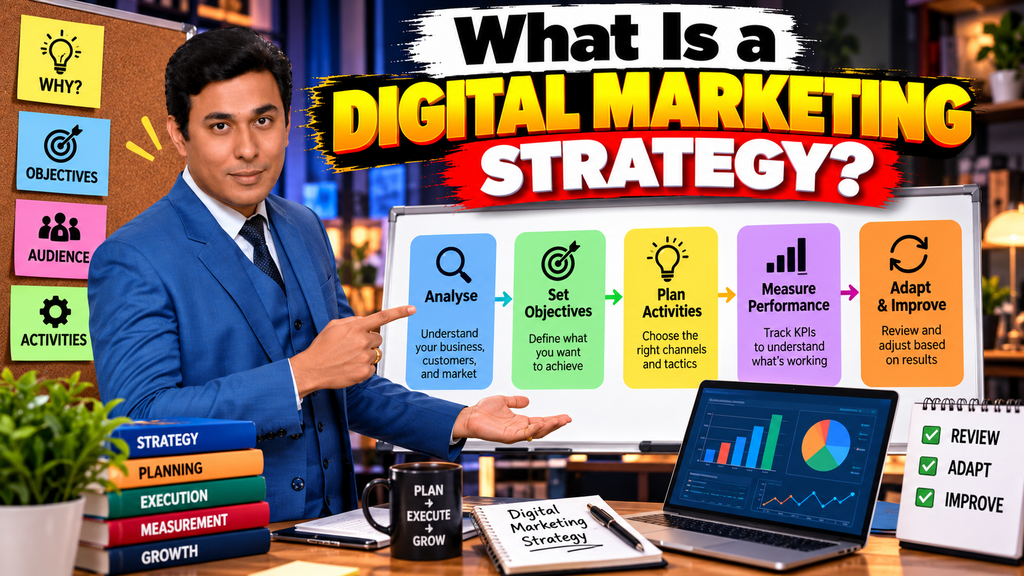
Here are the essential elements of a digital marketing strategy.
1. Identifying Your Digital Marketing Objectives
What do you want digital marketing to accomplish?
Do you want to generate qualified leads, increase online sales, improve brand awareness, attract store visits, or retain existing customers?
Your objectives should be specific enough to measure.
For example, instead of saying, “I want more leads,” you might aim to generate 100 qualified enquiries per month within a defined budget.
2. Understanding Your Business Category
Every business operates differently. A local service provider, an e-commerce store, a coaching institute, and a B2B software company cannot necessarily follow the same marketing approach.
Your business model, average order value, profit margins, sales cycle, and geographical reach influence your marketing decisions.
Understanding these factors helps you choose suitable objectives and channels.
3. Conducting Market and Competitor Analysis
Study your competitors, their positioning, the offers they promote, the channels they use, and the gaps they leave in the market.
The goal isn’t to copy their activities. It is to identify opportunities to differentiate your business and communicate a stronger value proposition.
4. Defining Your Target Audience
Identify your ideal customers, their needs, their purchasing behaviour, their concerns, and the problems they want to solve.
Understanding your audience allows you to develop relevant messages instead of creating generic marketing content for everyone.
5. Selecting the Right Digital Marketing Channels
Your audience may discover businesses through Google Search, social media, YouTube, email, online communities, or paid advertisements.
You need to determine which channels are appropriate for your objectives, audience, and budget.
6. Building a Content Strategy
Decide what content you need, which questions it should answer, where it will be published, and how it will guide customers towards taking action.
Your content could include blog articles, videos, case studies, product demonstrations, social media posts, or email campaigns.
7. Building the Right Execution Team
Finally, determine who will implement the strategy.
Depending on your requirements, you might need an internal marketing team, freelancers, a digital marketing agency, or a combination of these resources.
Once these elements are clearly defined, you have a strategic foundation to guide your digital marketing activities.
7 Ways a Digital Marketing Strategy Can Improve Your Results
Now, let’s explore seven practical ways a digital marketing strategy can help your business avoid unnecessary expenses and improve marketing performance.
1. You Know What to Do and How to Measure Success
Without clear objectives, businesses often measure success using superficial metrics such as impressions, likes, clicks, and followers.
These numbers can be useful, but they don’t always indicate whether your marketing is contributing to business growth.
A strategy connects your activities to meaningful key performance indicators (KPIs).
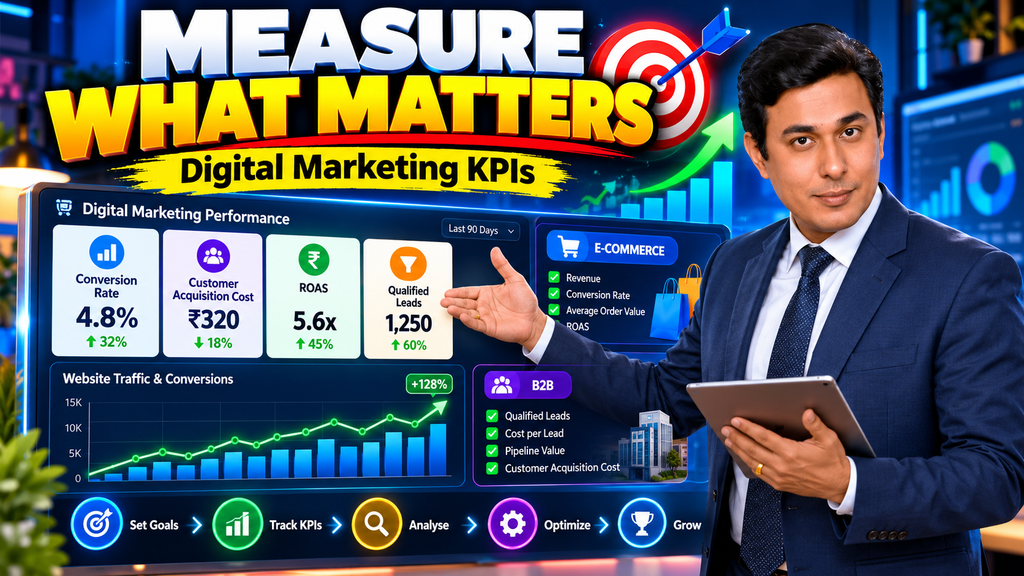
For example, an e-commerce business might track conversion rate, customer acquisition cost, average order value, and return on advertising spend.
A B2B business might focus on qualified leads, cost per qualified lead, sales opportunities, and revenue generated.
When you know which metrics matter, you can establish benchmarks, evaluate performance, and make better decisions about your budget.
2. You Understand Your Business and Competitors Better
Effective marketing requires more than knowing your products or services. You also need to understand what makes your business valuable to customers and how that value compares with competing alternatives.
Suppose you run a digital marketing institute.
Your competitors might promote affordable courses, certifications, or placement assistance. Rather than repeating the same claims, you could differentiate your institute through practical projects, mentorship, industry-relevant skills, and demonstrable student outcomes—provided you can substantiate those claims.
A clear strategy helps you identify your competitive advantages and communicate them consistently.
As a result, your marketing becomes more focused and persuasive.
3. You Stop Wasting Money on the Wrong Audience
One of the most expensive digital marketing mistakes is reaching people who are unlikely to become customers.
Imagine you run a premium coaching institute. Your advertisements generate thousands of clicks, but most visitors are looking for free resources or courses outside your geographical area.
You might be paying for traffic without generating meaningful business opportunities.
A strategy helps you define your ideal audience, identify their needs, select suitable targeting criteria, and develop relevant offers.
It also encourages you to evaluate traffic quality rather than focusing exclusively on the number of clicks.
Remember: more traffic is not necessarily better traffic. The goal is to attract people who are relevant to your business.
4. You Invest in the Right Marketing Channels
Every digital marketing channel serves a different purpose.
Search engine optimization can help you attract people searching for relevant information or services. Paid search can reach users with specific search intent. Social media can support discovery and engagement, while email marketing can help nurture relationships with existing leads and customers.
The right combination depends on your audience, objectives, competition, budget, and available resources.
For instance, a local plumber may benefit from local SEO and high-intent search advertising more immediately than from investing heavily in a broad social media awareness campaign.
That doesn’t mean social media is ineffective. It means channel selection should be based on business requirements rather than trends or assumptions.
A well-defined strategy helps you prioritize the channels most likely to contribute to your goals.
5. You Understand Your Customers’ Problems Better
People rarely purchase a product or service simply because a business wants to sell it. They purchase because they believe it can solve a problem, fulfil a need, or deliver a desired outcome.
Understanding customer pain points allows you to create marketing messages that address those needs directly.
Consider a business selling accounting software to small businesses.

Instead of promoting a long list of technical features, the company could explain how the software helps business owners organize invoices, monitor expenses, and reduce manual administrative work.
The product hasn’t changed. The communication has become more relevant to the customer’s needs.
A digital marketing strategy helps you identify these concerns and align your messaging with the problems your audience wants to solve.
6. You Create More Relevant and Effective Content
Publishing content consistently is useful, but consistency alone does not guarantee results.
Your content needs to serve a purpose.
Some content attracts new audiences. Other content educates potential customers, addresses objections, compares alternatives, or encourages conversions.
For example, someone searching for “what is Google Ads?” may be looking for educational information. Someone searching for “Google Ads agency for e-commerce” may be closer to choosing a service provider.
These users have different intentions and need different content.
A content strategy maps topics to customer needs and stages of the buying journey. It also helps you decide which formats and distribution channels are appropriate for each piece of content.
The result is a more organized content operation with a clearer connection between publishing activities and business objectives.
7. You Know Whom to Hire and How to Evaluate Them
Should you hire an in-house marketer, work with freelancers, or appoint a digital marketing agency?
Without a strategy, it can be difficult to answer this question.
You might hire a social media manager when your primary challenge is poor website conversion. Alternatively, you might invest in SEO when your immediate business requirement is generating leads from a new market within a short timeframe.
A strategy helps you identify the capabilities required to execute your marketing activities.
It also gives you a framework for evaluating agencies and employees. Instead of judging performance solely by the number of posts published or advertisements launched, you can assess progress against agreed objectives, deliverables, budgets, and KPIs.
This creates greater accountability and helps you make better hiring and investment decisions.
How Can You Start Building a Digital Marketing Strategy?
You don’t need an unnecessarily complicated document to get started.
Begin by answering a few important questions:
- What business outcome do I want to achieve?
- Who is my ideal customer, and what problem am I solving?
- What are my competitors doing, and where are the opportunities?
- Which marketing channels are most suitable for my audience?
- What content, budget, tools, and people do I need?
- Which KPIs will tell me whether my efforts are working?
- How frequently will I review performance and adjust my approach?
Document your answers and translate them into practical monthly or quarterly activities.
Track the results, learn from the data, and revise your approach when the evidence suggests a change is necessary.
Remember that a strategy isn’t a document you create once and never revisit. It should evolve as your business and market conditions change.
Conclusion: Stop Spending Before You Start Thinking
Digital marketing offers businesses tremendous opportunities, but investing money in digital channels doesn’t automatically guarantee growth.
You can run advertisements, publish content, hire an agency, and use advanced marketing tools. Yet, without a clear understanding of your objectives, customers, channels, and performance metrics, your efforts may fail to deliver the expected results.

A digital marketing strategy gives your activities direction. It helps you reduce avoidable waste, make better decisions, communicate more effectively, and allocate resources according to your business priorities.
No strategy can eliminate every risk or guarantee success. However, a well-researched, measurable, and adaptable strategy can improve your ability to identify problems early and make informed decisions before they become expensive mistakes.
Every business matters, and every marketing investment deserves careful consideration.
So, before you spend more money on digital marketing, do your homework first. Build your strategy, understand your audience, and decide how you’ll measure success.
In my next article, I’ll explain how to create a digital marketing strategy for your business, including how to choose the right channels, determine your investment, identify the people you need, and measure results effectively.
Because successful digital marketing doesn’t begin with launching a campaign. It begins with understanding why you’re launching it in the first place.
Frequently Asked Questions
1. What is a digital marketing strategy?
A digital marketing strategy is a structured approach to achieving business objectives through online marketing. It defines your target audience, marketing channels, messaging, content approach, resources, and performance metrics.
2. Why is a digital marketing strategy important?
It helps businesses prioritize marketing activities, understand their customers, allocate budgets more effectively, measure results, and reduce avoidable spending on poorly targeted or ineffective campaigns.
3. What are the main elements of a digital marketing strategy?
The main elements include business objectives, audience research, competitor analysis, channel selection, content planning, budget allocation, execution resources, and performance measurement.
4. Can a digital marketing strategy guarantee results?
No. Results depend on several factors, including market conditions, competition, product quality, execution, budget, and customer behaviour. A strategy provides direction and a framework for learning and improvement, but it cannot guarantee specific outcomes.
5. How often should a digital marketing strategy be reviewed?
Review performance regularly, often monthly, and conduct a broader strategic review quarterly. The appropriate frequency depends on your business, campaign duration, data volume, and how quickly market conditions change.
6. Should a small business have a digital marketing strategy?
Yes. A small business can benefit from a simple strategy that identifies its ideal customers, prioritizes a few suitable channels, establishes a realistic budget, and measures meaningful results. A strategy doesn’t need to be complicated to be useful.

Related Posts