
Uses your browser’s reading voice.
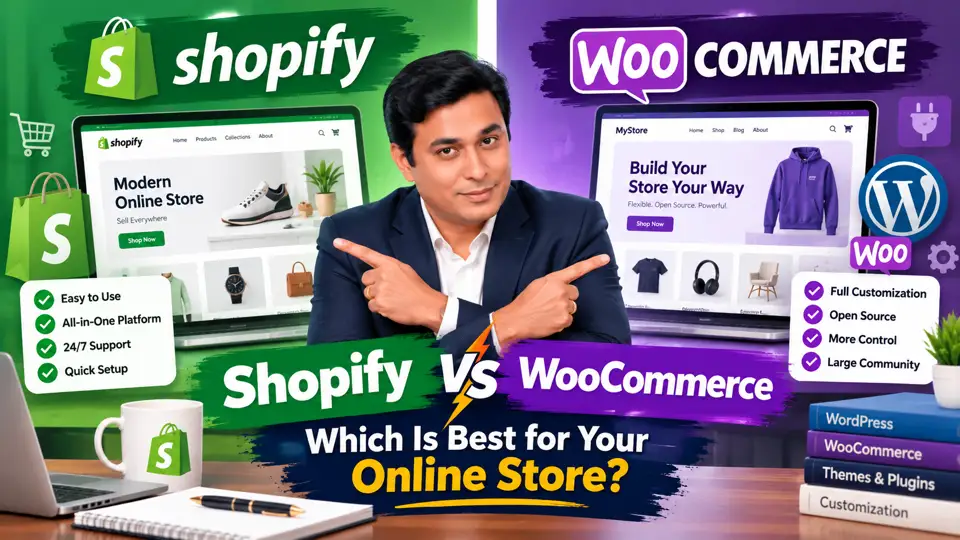
Planning to launch an online store? One of the first decisions you'll need to make is which ecommerce platform to use.
You might have heard people recommend Shopify because it is easy to set up. Others might tell you that WooCommerce is better because it gives you more control over your website.
So, which one should you choose?
The answer depends on what you want to sell, how much control you need, your technical skills, and the amount of time and money you can invest in managing your store.
For example, a small business owner who wants to start selling products quickly may prefer Shopify. A business that needs extensive customization, control over its website infrastructure, or advanced content marketing capabilities may find WooCommerce more suitable.
Both platforms can support successful ecommerce businesses. The goal is not to choose the platform with the most features. It is to choose the one that fits your business requirements.
In this guide, we'll compare Shopify vs WooCommerce in terms of ease of use, cost, customization, SEO, maintenance, and scalability so you can make an informed decision.
What Is Shopify?
Shopify is a hosted ecommerce platform that allows businesses to create online stores, manage products, accept payments through supported payment providers, and handle orders from a central dashboard.
Because Shopify is a hosted service, you don't need to arrange separate web hosting or manually manage the platform's core software updates.
You can choose a theme, customize your store's appearance, add products, configure shipping options, connect supported payment methods, and publish your store.
Shopify also provides access to an ecosystem of apps and integrations that can extend your store's functionality.
For example, if you want to sell clothing online, you can use Shopify to create product pages, organize sizes and colors, manage inventory, and process orders. Depending on your requirements, you can add apps for reviews, email marketing, customer support, and other functions.
Shopify is particularly attractive to entrepreneurs who want to spend more time on products, marketing, and customer service rather than managing website infrastructure.
However, Shopify is a subscription-based service, and your total costs may include paid themes, apps, payment processing, and other services.
What Is WooCommerce?
WooCommerce is an open-source ecommerce plugin for WordPress. It adds online store functionality to a WordPress website, allowing you to manage products, orders, payments, shipping, and other ecommerce activities.
Unlike Shopify, WooCommerce generally requires you to arrange your own hosting and manage more aspects of your website's technical setup.
The WooCommerce plugin itself is available without a mandatory platform subscription fee, but running a store can involve costs for hosting, a domain, premium extensions, themes, development, security, and maintenance.
One of WooCommerce's biggest advantages is flexibility.
Because WordPress and WooCommerce are open-source, developers can customize the website's code and functionality, subject to the applicable software licenses and technical requirements. You can also choose from a wide range of themes, plugins, and integrations.
For example, imagine you want to create an online store that also publishes hundreds of educational blog articles, comparison guides, and product tutorials. WooCommerce can combine ecommerce functionality with WordPress's content management capabilities in a highly customizable environment.
However, that flexibility comes with responsibility. You or your service provider must manage hosting, updates, backups, security, compatibility, and performance.
Shopify vs WooCommerce: Quick Comparison
| Feature | Shopify | WooCommerce |
|---|---|---|
| Platform type | Hosted ecommerce service | Open-source WordPress plugin |
| Ease of use | Generally easier for beginners | Requires more setup and management |
| Hosting | Included in the platform service | Arranged separately |
| Initial software cost | Subscription required | Core plugin available free |
| Customization | Themes, apps, settings, and code options | Extensive control over code and plugins |
| Maintenance | Core infrastructure managed by Shopify | More responsibility for the store owner or developer |
| Technical support | Official support and documentation, depending on the issue and plan | Community, documentation, hosting support, and developers |
| SEO | Core SEO features and app ecosystem | Flexible SEO customization through WordPress and plugins |
| Best suited for | Businesses seeking a managed ecommerce solution | Businesses seeking greater technical control and flexibility |
Your actual costs and available features depend on your plan, hosting provider, selected apps or extensions, and business requirements.
1. Ease of Use: Which Platform Is Better for Beginners?
If you have never built an ecommerce website before, ease of use should be an important consideration.
Shopify: Easier to Get Started
Shopify is designed to simplify the process of launching an online store.
You can create an account, choose a theme, add products, configure essential settings, and work toward publishing your store without separately installing WordPress or configuring a web server.
Its managed infrastructure also reduces the amount of technical maintenance you need to handle yourself.
This can be particularly useful if you are a business owner who wants to focus on sourcing products, running advertisements, managing orders, and serving customers.
Shopify still requires learning. You need to understand product organization, payment configuration, shipping rules, store design, and ecommerce operations. However, the platform handles much of the underlying infrastructure.
WooCommerce: More Setup, More Responsibility
WooCommerce gives you more control, but setting up a store usually involves additional steps.
You need to choose hosting, install WordPress, configure WooCommerce, select a theme, set up payments and shipping, and ensure the website works correctly.
Depending on your hosting provider, many of these tasks can be simplified through managed WordPress hosting and installation tools.
Nevertheless, you may need technical assistance when plugins conflict, updates cause problems, or the website needs custom functionality.
Verdict: Shopify is generally the better starting point for beginners who want a managed setup. WooCommerce can also work for beginners, particularly with managed hosting and reliable technical support, but expect a steeper learning curve.
2. Cost: Which Ecommerce Platform Is More Affordable?
Cost is one of the most important factors when comparing Shopify vs WooCommerce.
However, comparing only the monthly subscription fee or the price of the software can be misleading. You should estimate the total cost of running the store.
Shopify Costs
Shopify typically charges a recurring subscription fee. Depending on your needs, additional expenses may include:
- Premium themes or design work
- Paid apps and integrations
- Payment processing fees
- Third-party transaction fees where applicable
- Domain registration
- Marketing and email tools
- Custom development
The advantage is that many core infrastructure expenses are bundled into the service, making budgeting more predictable.
However, subscription and app costs can increase as your business grows.
WooCommerce Costs
WooCommerce's core plugin is available for free, but operating a professional online store still costs money.
Potential expenses include:
- Domain registration
- Web hosting
- Premium themes
- Paid extensions
- Payment processing
- Security and backup services
- Developer fees
- Ongoing maintenance and optimization
A simple store using a suitable free theme and a modest hosting plan may be relatively inexpensive to launch. A complex store with custom features, high traffic, and specialist support can cost substantially more.
Which Platform Is Cheaper?
WooCommerce can be more cost-effective if you can manage the technical side yourself and select appropriate tools. Shopify may offer better overall value if you prefer a managed platform and want to reduce maintenance responsibilities.
The right comparison is not simply free versus paid. It is the total cost of ownership, including your time, technical support, maintenance, and business requirements.
Before choosing, calculate your expected expenses for at least the first year and consider how those expenses might change as your store grows.
3. Customization and Flexibility
Your ecommerce website represents your business. Its design, functionality, checkout experience, and product presentation can all influence how customers perceive your brand.
This is where the differences between Shopify and WooCommerce become particularly important.
Shopify Customization
Shopify provides themes, settings, apps, and developer tools for customizing your store.
You can adjust colors, typography, product layouts, navigation, and other design elements. Developers can also work with Shopify's supported customization options and theme code.
However, Shopify operates within a managed platform. Some changes depend on the platform's capabilities, APIs, app ecosystem, and plan-specific features.
If you need a specialized feature, you may need an app or custom development.
WooCommerce Customization
WooCommerce offers extensive flexibility because it runs on WordPress and can be modified through themes, plugins, custom code, and integrations.
You can create custom product pages, introduce specialized workflows, connect external systems, and modify many aspects of the store's functionality.
For businesses with unusual requirements, this flexibility can be a major advantage.
However, customization is not always simple. More plugins and custom code can increase maintenance requirements and introduce compatibility or security risks if they are poorly managed.
Verdict: WooCommerce generally provides greater technical control. Shopify can still support extensive customization, but it operates within a managed ecosystem.
4. SEO: Shopify vs WooCommerce
Search engine optimization can help an ecommerce website attract customers without paying for every visit.
Both Shopify and WooCommerce can support effective SEO. Neither platform automatically guarantees high rankings.
Your results depend on factors such as content quality, product information, website performance, site structure, competition, and how effectively your pages meet search intent.
Shopify SEO
Shopify includes important SEO capabilities, such as editable page titles and meta descriptions, customizable URL handles in supported areas, canonical URL handling, and automatically generated XML sitemaps.
You can also improve product descriptions, create useful collection pages, optimize images, publish blog content, and use apps or supported customizations for additional functionality.
Some URL structures and technical elements are controlled by the platform, so you may have less freedom over certain implementation details than you would on a self-managed WordPress website.
WooCommerce SEO
WooCommerce benefits from WordPress's content management capabilities and its ecosystem of SEO plugins.
Depending on your setup, you can customize page metadata, schema markup, internal linking, content structure, and many other technical elements.
You also have greater control over hosting and server-level performance optimization.
However, greater control does not mean better SEO by default. A slow WooCommerce website with duplicate content, poor product descriptions, or broken navigation can perform worse than a well-maintained Shopify store.
Verdict: Both platforms can rank well in search engines. WooCommerce offers more flexibility for businesses that need extensive technical control, while Shopify provides a convenient foundation for stores that want to manage SEO without taking full responsibility for their infrastructure.
5. Maintenance, Security, and Technical Support
An online store is not a one-time project. It requires ongoing attention to security, performance, updates, backups, and customer experience.
Shopify Maintenance
Shopify manages the core hosting infrastructure and platform updates. This reduces the need for store owners to maintain servers or manually update the ecommerce platform itself.
However, you still need to manage store settings, staff access, app permissions, product data, fraud prevention, and business continuity.
Third-party apps and integrations can also introduce their own maintenance requirements.
Shopify offers official support resources and support channels, although the availability and scope of assistance can depend on the issue and current support arrangements.
WooCommerce Maintenance
With WooCommerce, you or your hosting provider generally take more responsibility for the website's technical health.
Tasks may include updating WordPress, WooCommerce, themes, and plugins; maintaining backups; monitoring security; and checking that updates do not break important functionality.
Managed WordPress hosting can reduce this workload, and developers or maintenance services can handle more complex tasks.
However, these services may add to your operating costs.
Verdict: Shopify is usually the simpler choice if you want to minimize infrastructure management. WooCommerce is suitable if you want more control and are prepared to manage maintenance yourself or pay someone to do it.
6. Which Platform Is Better for Scaling an Ecommerce Business?
Both platforms can support growing ecommerce businesses, but scaling involves more than selecting software.
As your business grows, you may need better inventory management, improved reporting, faster pages, additional sales channels, automated workflows, and integrations with accounting or customer relationship management systems.
Shopify offers a managed infrastructure and an app ecosystem that can help businesses expand without managing the underlying server environment themselves.
WooCommerce provides flexibility to customize the store's architecture and integrations, but performance and reliability depend heavily on hosting, caching, database optimization, plugin quality, and implementation.
A poorly configured store can struggle as traffic increases, regardless of the platform.
Before selecting either solution, identify your likely requirements over the next few years. Consider product volume, traffic, international selling, fulfillment, reporting, and the integrations your business will need.
Shopify vs WooCommerce: Which One Should You Choose?
The best platform depends on how you intend to operate your business.
Choose Shopify if:
- You want to launch a store with minimal technical setup.
- You prefer a managed ecommerce platform.
- You want to reduce responsibility for hosting and core software maintenance.
- You value a centralized interface for managing products and orders.
- You are comfortable with recurring subscription costs and the platform's ecosystem.
Choose WooCommerce if:
- You want extensive control over your website.
- You already use WordPress or need a content-heavy website.
- You want to customize functionality through plugins and code.
- You can manage hosting and maintenance or have access to technical support.
- You want more control over your hosting environment and software choices.
What If You Have a Limited Budget?
If your budget is limited, WooCommerce may be attractive because its core plugin does not require a platform subscription fee. However, you must still account for hosting, security, maintenance, payment processing, and other costs.
Shopify may be worth the subscription cost if it saves you significant time or reduces the need for technical assistance.
Estimate the total cost of running each platform instead of assuming that one will always be cheaper.
Frequently Asked Questions
Is Shopify better than WooCommerce?
Shopify is generally easier to manage, while WooCommerce offers greater technical flexibility. The better option depends on your budget, customization requirements, technical skills, and preferred maintenance model.
Is WooCommerce free to use?
The core WooCommerce plugin is available for free. However, you may need to pay for hosting, a domain, premium extensions, themes, development, security, and maintenance.
Is Shopify easier than WordPress and WooCommerce?
For many beginners, yes. Shopify provides a managed ecommerce environment, while WooCommerce requires a WordPress installation and additional configuration. Managed WordPress hosting can make WooCommerce easier to operate.
Which platform is better for SEO?
Both Shopify and WooCommerce can support strong SEO performance. WooCommerce offers greater technical flexibility, while Shopify provides useful built-in SEO capabilities. Rankings depend on the quality and implementation of your SEO strategy, not just the platform.
Can I migrate from Shopify to WooCommerce?
Yes, migration is possible. Products, customer information, orders, content, and other data may be transferred using migration tools or specialist services. The exact process depends on your store, and you should plan URL redirects, data validation, and SEO preservation before switching platforms.
Which platform is better for a small business?
Shopify can suit small businesses that want a managed solution and simple setup. WooCommerce can suit businesses that need greater flexibility or already operate a WordPress website. Both can work well for small stores.
Final Verdict
Shopify and WooCommerce are both capable ecommerce platforms, but they solve slightly different problems.
Shopify simplifies store management by providing a hosted environment and reducing the technical responsibilities associated with running an ecommerce website. WooCommerce gives you greater control over your website's software, hosting, and customization, but requires more planning and maintenance.
If your priority is convenience and a faster route to launching an online store, Shopify is a strong option.
If your priority is flexibility, ownership of your hosting environment, and deeper customization, WooCommerce may be the better fit.
Before you decide, evaluate the total cost, technical resources, marketing requirements, and long-term goals of your business. Choosing the right platform from the beginning can make it easier to manage your store, improve the customer experience, and grow sustainably.