
Uses your browser’s reading voice.
When running Meta Ads, one of the biggest challenges is understanding what happens after someone clicks an advertisement. Did the visitor purchase a product, submit a lead form, register for a course, or leave without taking action?
Without reliable conversion tracking, it becomes difficult to determine which campaigns are generating valuable results.
This is where Meta Pixel and Conversions API come into the picture. Both help businesses send event data to Meta, but they use different methods to collect and transmit that information.
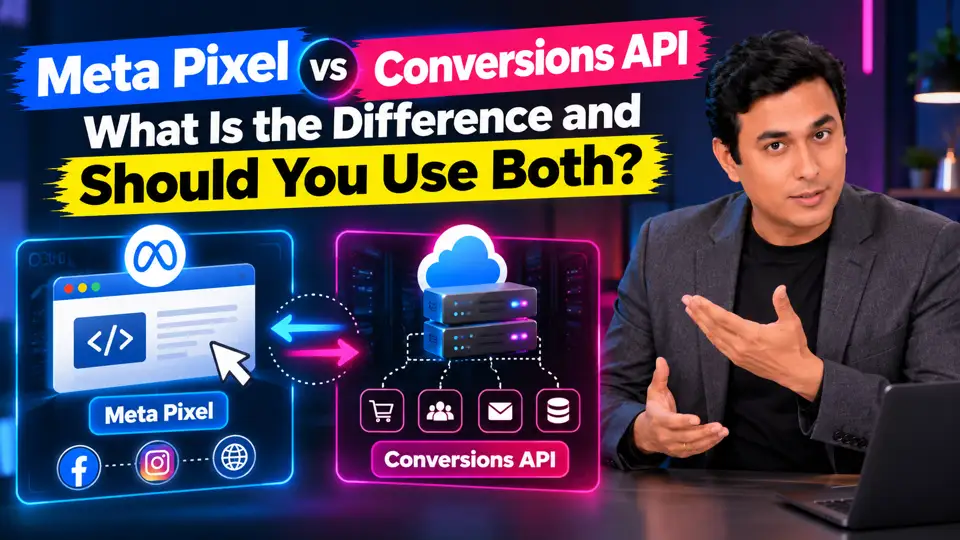
Meta Pixel sends events from a visitor's browser, while Conversions API allows a business to send events from its server or another supported integration.
For many businesses, using both can create a more robust measurement setup. However, the implementation must be accurate, duplicate events must be handled correctly, and privacy requirements must be respected.
In this guide, you'll learn how Meta Pixel and Conversions API work, their key differences, and when your business should use one or both.
What Is Meta Pixel?
Meta Pixel is a piece of JavaScript code that you add to your website to measure visitor activity and send supported events to Meta.
It helps businesses understand actions people take on their websites after interacting with Facebook or Instagram advertising, subject to the available tracking signals and user privacy choices.
For example, imagine you run a digital marketing institute. Someone sees your Instagram advertisement, visits your course page, checks the fees, and submits an admission enquiry form.
With Meta Pixel configured correctly, your website can send events such as:
- PageView: A page is viewed.
- ViewContent: A visitor views a relevant piece of content, such as a course or product page.
- Lead: A visitor completes a lead-generating action.
- AddToCart: A visitor adds a product to a shopping cart.
- Purchase: A purchase is completed.
These are examples of standard Meta Pixel events. The event names and the conditions that trigger them should reflect what actually happens on your website.
How does Meta Pixel work?
When a visitor loads a page where the Pixel is installed, the browser can execute the tracking code and send eligible event information to Meta.
This information can help with conversion measurement, audience creation, and campaign optimization, depending on your configuration and the features available to your account.
However, browser-based tracking has limitations. Browser settings, ad blockers, network problems, consent choices, and other privacy controls can affect whether an event is sent or received.
Meta Pixel is still useful for many websites, particularly when businesses need a straightforward starting point for measuring website activity.
What Is Meta Conversions API?
Meta Conversions API, commonly called CAPI, is a way to send event data from a business's server or another supported integration directly to Meta.
Unlike browser-only tracking, this approach does not depend solely on a JavaScript event running in the visitor's browser.
Depending on the integration, event information may come from a website server, ecommerce platform, customer relationship management (CRM) system, or another supported business system.
For example, imagine a person submits an enquiry form for your digital marketing course. Your website stores the enquiry in your CRM, and your system sends a corresponding lead event to Meta through Conversions API.
You can also send suitable downstream events, such as a qualified lead or completed sale, when your systems record those outcomes and the integration supports them.
How does Conversions API work?
A typical implementation follows this process:
- A customer performs an action, such as submitting a form or completing an order.
- Your website server or connected business system records the action.
- The integration sends an event and the required parameters to Meta.
- Meta processes the event for eligible measurement and advertising purposes.
Conversions API can help businesses establish a more direct and reliable data connection with Meta. However, it does not guarantee that every conversion will be captured or attributed to an advertisement.
Its effectiveness depends on correct implementation, event quality, available data, matching information, and compliance with applicable privacy requirements.
Meta's official Conversions API training explains implementation options and responsible data sharing.
Meta Pixel vs Conversions API: Key Differences
| Feature | Meta Pixel | Conversions API |
|---|---|---|
| Data source | Visitor's browser | Server or supported business integration |
| Main purpose | Measure eligible browser-based website activity | Send eligible event data through a server-side or supported connection |
| Implementation | JavaScript code or a supported platform integration | Partner integration, server configuration, or another supported setup |
| Browser dependency | Relies on browser execution and available tracking signals | Does not rely solely on browser execution |
| Data coverage | May miss events because of browser or network limitations | May provide additional event signals from business systems |
| CRM and offline outcomes | Not designed by itself to capture every downstream business event | Can support eligible events from connected systems, depending on the integration |
| Technical complexity | Often simpler for basic website tracking | Varies from simple partner setups to more advanced technical implementations |
| Common use cases | Page views, product views, leads, purchases | Website conversions, qualified leads, purchases, and other supported events |
| Main limitation | Browser-side tracking can be incomplete | Incorrect configuration or limited source data can still lead to missing or inaccurate events |
The two tools are not necessarily alternatives. They can complement one another when configured correctly.
What Is the Main Difference Between Meta Pixel and Conversions API?
The main difference is where the event information comes from and how it reaches Meta.
Meta Pixel uses the browser: The visitor's browser executes the tracking code and sends eligible events.
Conversions API uses a server or supported integration: Your system sends event information directly to Meta through the configured connection.
Think of an ecommerce store as an example. A browser-based Pixel event might record that a customer viewed a product. The store's order system can separately send a purchase event through Conversions API after the order is recorded.
Both methods can provide useful information, but they depend on different parts of the tracking setup.
It is also important to understand that Conversions API does not automatically bypass user privacy choices or make all previously unavailable data accessible. Businesses still need to follow applicable consent requirements and Meta's data-sharing policies.
Why Should Businesses Use Meta Pixel and Conversions API Together?
For many businesses, using both methods is worth considering because each can provide event information from a different source.
Pixel can capture eligible browser activity, while Conversions API can send events recorded by the server or a connected business system.
This complementary approach can help improve the completeness and reliability of event measurement. It may also provide Meta with more useful conversion signals for eligible advertising optimization.
Example: An ecommerce business
Suppose an online store sells clothing.
A customer views a product, adds it to the cart, and completes an order.
The store might use Meta Pixel to send browser events for product views and cart activity. Its ecommerce platform or server integration can also send purchase information through Conversions API.
If the purchase is sent through both methods, the business must configure event deduplication correctly so that the same order is not counted twice.
Example: A lead generation business
Suppose a coaching institute runs Meta Ads to attract course enquiries.
A visitor submits a form, and the website sends a Lead event. The CRM later identifies whether the enquiry is qualified or whether the person actually enrols.
With an appropriate integration, the business may send the relevant downstream event through Conversions API. This can provide additional information about lead quality beyond the initial form submission.
The business should only send events that accurately represent real actions and are permitted under the relevant policies and privacy requirements.
What Is Event Deduplication and Why Does It Matter?
Event deduplication is essential when you use Meta Pixel and Conversions API to send the same event.
Imagine that a customer completes one purchase. Your Pixel sends a Purchase event, and your server sends another Purchase event for that same order.
If Meta treats these as separate purchases, your reporting may show two conversions even though only one order occurred.
That can distort campaign performance and make optimization decisions less reliable.
How does Meta deduplicate events?
For the standard browser-and-server deduplication setup, the two copies should use:
- The same event name, such as
Purchase. - The same event ID for that particular action.
- The appropriate shared data source and correct event configuration.
The browser event uses an eventID parameter, while the server event uses event_id.
For example, both copies of one purchase could share a unique order-related event ID. The same ID should not be reused for unrelated purchases.
Meta can then recognize the matching events and process them as duplicates rather than treating them as two separate conversions.
See Meta's Conversions API resources for guidance on implementation and measurement best practices.
Important: Installing Pixel and Conversions API without verifying deduplication can create misleading conversion counts. Test the setup before relying on the reporting for campaign decisions.
When Should Businesses Use Meta Pixel Only?
Meta Pixel may be a reasonable starting point for businesses with simple tracking needs and limited technical resources.
Consider starting with Pixel if:
- You have a basic website.
- You want to measure page views, leads, or purchases.
- You are new to Meta Ads tracking.
- Your website platform provides a straightforward Pixel integration.
- You want to validate your event setup before adding more complexity.
For example, a small service business may initially need to track a few important website actions, such as visits to a service page and completed enquiry forms.
Start by ensuring that the events are accurate and useful. You can consider adding Conversions API later if you have a clear business need and a suitable integration.
When Should Businesses Use Conversions API?
Conversions API is particularly worth considering when the business has important event data that can be sent from a server or supported business system.
It may be useful if:
- Browser tracking alone does not provide sufficient event coverage.
- You operate an ecommerce store with reliable order data.
- You use a CRM to manage leads and sales.
- You want to send qualified-lead or completed-sale events where supported.
- You need to connect website activity with other eligible business events.
- You have the technical resources or platform integration needed to maintain the setup.
Conversions API can be implemented through supported partner integrations, direct integrations, or other available solutions. The best method depends on your website platform, the events you need to send, and the technical capabilities of your systems.
Do not implement CAPI simply because it sounds more advanced. First identify which measurement problem it is intended to solve.
How to Set Up Meta Pixel and Conversions API Correctly
The exact process varies by platform and integration, but the following workflow provides a practical starting point.
Step 1: Identify the conversions that matter
Decide which actions are important to your business.
For ecommerce, these might include product views, add-to-cart actions, checkout events, and purchases. For a service business, they may include lead submissions, qualified leads, and completed sales.
Avoid tracking large numbers of events without a clear purpose.
Step 2: Configure Meta Pixel
Install the Pixel using the method supported by your website platform or implementation.
Configure the relevant events and confirm that they fire when the corresponding actions occur.
For example, a Lead event should represent a genuine lead submission rather than a page view that happens before the form is completed.
Step 3: Choose a suitable Conversions API integration
Review the integrations available for your website platform or CRM.
A supported partner integration may simplify setup. A direct integration may offer more control but can require developer resources and ongoing maintenance.
Send the appropriate event data from the system that records the actual action.
Step 4: Configure event deduplication
If the same event is sent by both Pixel and Conversions API, configure matching event names and event IDs as required.
Test that one real action does not appear as two separate conversions in your measurement setup.
Step 5: Test events and review diagnostics
Use Meta's available event testing and diagnostic tools to check whether events are received correctly.
Verify that:
- Important events are firing.
- Event names match the actions being measured.
- Purchase values and currencies are accurate where relevant.
- Duplicate events are handled properly.
- Server events contain the required parameters.
- Events represent genuine, permitted business actions.
Continue reviewing the setup after website updates, plugin changes, or checkout modifications.
Common Meta Pixel and Conversions API Mistakes to Avoid
1. Counting the same conversion twice
Sending the same event from the browser and server without correct deduplication can inflate conversion reporting.
2. Tracking the wrong action
A button click is not always a completed lead, and a checkout visit is not the same as a purchase. Define events according to what actually happened.
3. Sending inaccurate purchase information
For ecommerce, check order values, currencies, and event timing. Incorrect information can make campaign performance harder to evaluate.
4. Assuming Conversions API captures everything
CAPI still depends on your systems recording the event, the integration working correctly, and the required information being available and permitted for use.
5. Ignoring privacy and consent requirements
Server-side tracking does not eliminate privacy obligations. Follow applicable laws, consent requirements, and Meta policies. Do not send sensitive personal information through tracking events.
6. Sending too many low-quality events
More events do not automatically improve advertising performance. Focus on accurate signals that align with your business objectives.
Frequently Asked Questions
Is Meta Pixel the same as Conversions API?
No. Meta Pixel sends eligible website events from a visitor's browser, while Conversions API sends event data from a server or another supported integration. Both can be used to measure conversions.
Is Conversions API better than Meta Pixel?
Neither is universally better. Pixel is useful for browser-based tracking, while Conversions API can provide additional event signals from servers and supported business systems. Using both can be beneficial when the implementation is accurate.
Should small businesses use Meta Pixel and Conversions API together?
They can, but it depends on the business's needs and resources. A small business may begin with Pixel, verify its tracking, and add CAPI when it has a clear reason to improve event coverage or send relevant CRM data.
Does Conversions API bypass ad blockers?
Conversions API does not rely solely on browser execution, so it may provide event signals that browser tracking misses. However, it does not guarantee complete tracking or override consent choices, privacy requirements, or limitations in the available data.
Why is event deduplication important?
Deduplication helps Meta identify when the same action is sent through both Pixel and Conversions API. Without correct configuration, the same purchase or lead could be counted more than once.
Does using both improve Meta Ads performance?
Using both can improve the quality or completeness of measurement signals when implemented correctly. Better event data may support campaign optimization, but results also depend on targeting, creative quality, the offer, conversion rates, and other factors. Better tracking does not guarantee lower costs or more sales.
Conclusion
Meta Pixel and Conversions API serve related but different purposes in Meta Ads tracking.
Meta Pixel sends eligible website events through the visitor's browser, while Conversions API allows businesses to send event information from servers and other supported integrations.
For a business with basic tracking needs, Pixel can be a sensible starting point. Ecommerce businesses, lead generation companies, and advertisers with CRM data may benefit from using both methods when they can implement them properly.
The most important steps are to track meaningful actions, validate the data, configure event deduplication, and follow privacy requirements.
The goal is not simply to send more data to Meta. It is to send accurate, relevant, and permitted event data so you can measure campaign performance and make better advertising decisions.