
Uses your browser’s reading voice.
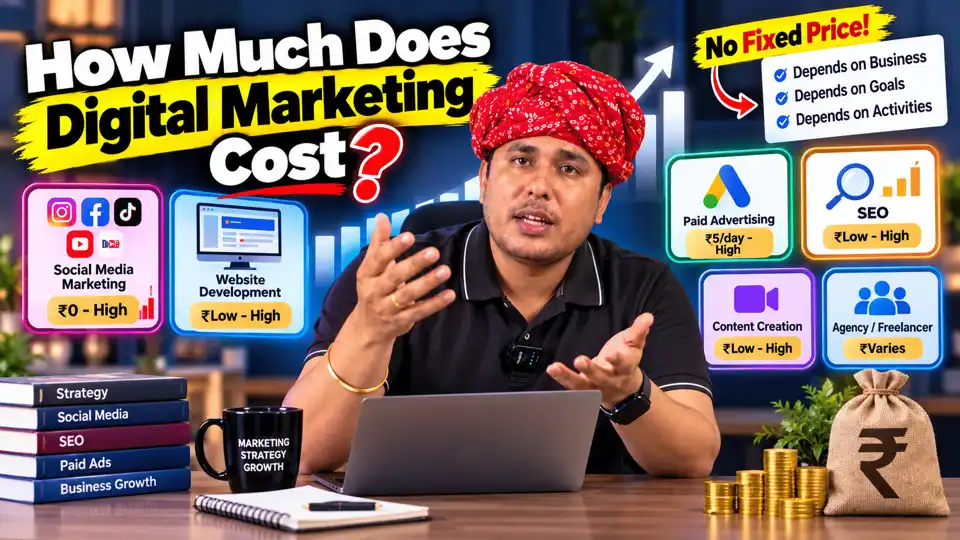
One of the most common questions business owners ask before investing in online growth is, "How much does digital marketing cost?"
The honest answer is that there is no fixed price. You can start with a small budget by creating your own content and promoting your business organically, or you can invest thousands of dollars every month in advertising, professional content production, search engine optimization (SEO), and marketing automation.
The right budget depends on your business model, competition, target audience, marketing goals, and the value of the customers you want to acquire.
For example, a local shop trying to attract customers from its surrounding area may not need the same investment as an e-commerce company targeting customers across an entire country.
In this guide, we will break down the major components of digital marketing costs, explain what influences pricing, and show you how to build a budget that supports your business goals without wasting money.
1. What Is the Average Cost of Digital Marketing?
There is no universal average that accurately represents every business. Digital marketing expenses vary depending on whether you manage activities yourself, hire freelancers, work with an agency, or build an in-house team.
Your total budget may include:
- Website development and maintenance.
- Social media content creation and management.
- Video production, editing, and graphic design.
- Search engine optimization.
- Paid advertising on platforms such as Google and Meta.
- Email marketing and marketing automation.
- Analytics, reporting, and conversion optimization.
The important distinction is that your total digital marketing budget is not the same as your advertising budget.
For example, if you allocate $500 per month to digital marketing, that amount may need to cover content production, management fees, software, and advertising. If you spend the entire amount on ads, your strategy and results will look very different.
Before deciding how much to spend, identify which activities are necessary to achieve your business objectives.
2. How Much Does Social Media Marketing Cost?
Social media marketing can be relatively inexpensive when you create and publish content yourself. However, professional production and ongoing management increase the overall cost.
Organic Social Media Marketing
Organic marketing involves publishing posts, Reels, Stories, and other content without paying for advertising distribution.
If you record videos on your smartphone, design posts using accessible tools, edit your own content, and manage your account independently, your direct expenses may be low.
However, your time still has value. Researching topics, preparing scripts, recording videos, editing content, responding to comments, and analyzing performance all require effort.
For example, a local restaurant could record short videos of food preparation, showcase customer favorites, and publish updates about special offers without hiring a production team.
This approach can help the business build awareness while keeping cash expenses manageable.
Professional Social Media Management
If you hire a social media manager, designer, video editor, photographer, or marketing agency, you must account for their fees.
Costs depend on the number of deliverables, content complexity, production quality, publishing frequency, reporting requirements, and the level of strategy involved.
A freelancer creating a few basic graphics will generally offer a different service from an agency handling content planning, video production, community management, paid campaigns, and performance reporting.
When comparing proposals, examine the actual deliverables rather than choosing solely on price.
Ask whether the service includes strategy, original content, revisions, publishing, reporting, and account management. Also clarify whether photography, travel, software, and advertising expenditure are charged separately.
3. How Much Does Website Development Cost?
Your website is often the foundation of your digital marketing strategy. It provides a place where potential customers can learn about your business, evaluate your services, and take action.
Website costs vary considerably depending on functionality and complexity.
Basic Business Website
A small business website might include a homepage, about page, service pages, contact information, and an enquiry form.
Platforms such as WordPress can make it possible to create a functional website without developing every feature from scratch.
Your expenses may include a domain name, hosting, a theme, essential plugins, initial setup, and ongoing maintenance.
If you build the website yourself, your cash expenses may be relatively low. Hiring a professional can increase the initial investment but may save time and improve usability, design, and technical implementation.
Professional or Custom Website
A more advanced website may require custom design, e-commerce functionality, payment integration, booking systems, customer accounts, CRM integration, or other business-specific features.
These requirements increase development and testing effort.
You should also consider recurring costs such as hosting, backups, security monitoring, software renewals, maintenance, and future improvements.
Does Having a Website Guarantee Google Rankings?
No. Launching a website does not automatically make it appear on the first page of Google.
Search visibility depends on multiple factors, including relevance, content quality, technical accessibility, competition, and the overall search experience.
SEO is a separate, ongoing activity that may require technical improvements, content development, internal linking, local optimization, and authority building.
Therefore, plan for both website development and the work needed to attract qualified visitors to it.
4. How Much Should You Spend on Paid Advertising?
Paid advertising allows businesses to pay for exposure on platforms such as Google Ads, Facebook, and Instagram.
One important point is that advertising creation costs and advertising media costs are two separate expenses.
Suppose you hire a video editor to create a promotional Reel for your business. You pay for producing the video. If you then run that Reel as a Meta ad, you also pay for the advertising delivery.
The total campaign cost includes both components, along with any applicable management fees and taxes.
Understanding Your Daily Advertising Budget
If you allocate $5 per day to advertising, the approximate budget for 30 days is:
$5 × 30 = $150.
At $10 per day:
$10 × 30 = $300.
These are illustrative calculations, not recommendations or guaranteed spending limits. Actual billing and delivery depend on the platform, campaign settings, and applicable rules.
For businesses operating in India, budgets can also be planned in rupees. The appropriate amount depends on your target market, service pricing, competition, and available funds.
Does Spending More Guarantee Better Results?
No. Increasing your advertising budget does not automatically produce more customers or higher profits.
Campaign performance depends on several factors:
- Audience: Are you reaching people who are likely to need your product or service?
- Offer: Is your product or service relevant and attractive?
- Creative: Does the advertisement communicate its value clearly?
- Landing page: Can visitors understand the offer and take the next step?
- Competition: How expensive is it to reach the intended audience?
- Tracking: Can you accurately measure leads, sales, and other conversions?
For example, a business spending $300 per month on a well-targeted campaign with a clear offer may perform better than a business spending $1,000 on poorly targeted ads.
Start with a manageable test budget, evaluate the quality of the leads or sales, and increase spending only when the evidence supports doing so.
5. How Much Does SEO Cost?
SEO pricing depends on the scale of your website, the competitiveness of your market, your current organic visibility, and the work required to improve performance.
A local service business targeting a limited geographic area may need a different level of investment from a national e-commerce company competing for highly competitive product searches.
Local SEO
Local SEO focuses on helping businesses appear for relevant searches associated with a location.
A local clinic, restaurant, coaching institute, or service provider may need assistance with Google Business Profile optimization, local landing pages, reviews, website improvements, and accurate business information.
The required workload depends on the business's existing online presence and local competition.
National and International SEO
Businesses targeting broader markets may need more extensive content planning, technical SEO, competitive research, information architecture improvements, digital PR, and ongoing performance analysis.
Large websites can also require additional work to address indexing problems, duplicate content, complex navigation, and thousands of product or category pages.
These factors can significantly affect the resources required.
Why SEO Should Be Treated as a Long-Term Investment
SEO does not generally provide the same immediate control over traffic that a live paid campaign can offer.
Improvements may take months to produce meaningful results, depending on the website, competition, and work involved. Rankings and organic traffic can also fluctuate.
Evaluate SEO using business outcomes such as qualified organic traffic, leads, sales, and customer acquisition costs rather than rankings alone.
When hiring an SEO professional or agency, ask what work will be performed, how progress will be measured, and which outcomes are realistic. Be cautious of guaranteed rankings or promises of instant results.
6. What Other Digital Marketing Expenses Should You Consider?
Your budget may need to cover more than website development, social media, SEO, and advertising.
Content Production
Professional photography, video recording, animation, copywriting, and graphic design can improve the presentation of your marketing messages.
The cost depends on the number of assets, production requirements, revisions, and expertise involved.
Email Marketing
Email marketing platforms may offer free plans for smaller lists, while advanced automation, segmentation, and higher sending volumes can require paid subscriptions.
Additional costs may arise from campaign strategy, copywriting, design, and list management.
Marketing Tools and Software
Businesses may pay for analytics tools, scheduling platforms, CRM software, keyword research tools, design applications, and reporting systems.
Do not purchase every tool available. Choose software based on actual workflow requirements and the value it provides.
Strategy and Management
A marketing strategy helps connect activities to business goals. Professional management may include planning, campaign setup, performance monitoring, reporting, and optimization.
These services should be evaluated according to the expertise and work involved, not simply the number of posts or advertisements delivered.
7. How to Calculate a Digital Marketing Budget for Your Business
Instead of copying another company's budget, work backward from your goals.
Consider a business that wants to generate 20 qualified enquiries per month.
Suppose its historical data suggests that approximately one in five qualified enquiries becomes a customer. It would need around 100 qualified enquiries to generate 20 customers, assuming that conversion rate remains consistent.
If the business also knows its acceptable customer acquisition cost and its current conversion rates, it can estimate the investment required and determine whether the plan is financially realistic.
Use the following process:
Step 1: Define your goal. Decide whether you want leads, sales, bookings, local awareness, or another measurable outcome.
Step 2: Understand customer value. Estimate the revenue and contribution margin associated with a typical customer.
Step 3: Select suitable channels. Choose SEO, paid search, social media, email marketing, or other activities based on your audience and buying journey.
Step 4: Separate costs. List service fees, advertising spend, production expenses, software, and maintenance independently.
Step 5: Set a test budget. Start with an amount your business can afford to test without putting essential operations at risk.
Step 6: Measure performance. Track qualified enquiries, sales, acquisition costs, and profitability.
Step 7: Reallocate intelligently. Increase investment in activities that produce reliable business value and improve or discontinue those that do not.
This approach creates a more useful budget than selecting an arbitrary monthly figure.
8. How Small Businesses Can Start Digital Marketing on a Limited Budget
A small business does not need to launch every marketing channel at once.
Start by establishing a clear online presence. Build a functional website or improve your existing one, make your contact details accurate, and ensure customers can easily understand what you offer.
Next, create useful content around questions your customers frequently ask. Demonstrate your products, explain your services, answer common objections, and share genuine customer experiences with permission.
Use free analytics and platform insights where appropriate to understand which content attracts attention and enquiries.
Once you have a clear offer and a suitable destination for potential customers, consider testing paid advertising with a controlled budget.
For example, a local service provider could initially focus on a well-structured website, local SEO, and regular educational content. After identifying a service with strong demand, it could test a targeted advertising campaign.
This phased approach allows you to learn what works before committing to a larger investment.
Conclusion: How Much Should You Spend on Digital Marketing?
There is no single digital marketing budget that works for every business.
Your expenses depend on your goals, competition, chosen channels, internal capabilities, and the value of the customers you want to acquire.
You can begin with organic content and a basic website, or you can invest in professional production, SEO, advertising, and advanced marketing systems. The right approach is the one that fits your business objectives and financial capacity.
Remember to distinguish advertising spend from service fees, website development from SEO, and traffic generation from profitable customer acquisition.
Start with clear goals, measure your results, and invest more as you develop reliable evidence about what works.
Digital marketing is not about spending the least amount of money. It is about investing in the right activities and generating enough business value to justify that investment.