
Uses your browser’s reading voice.
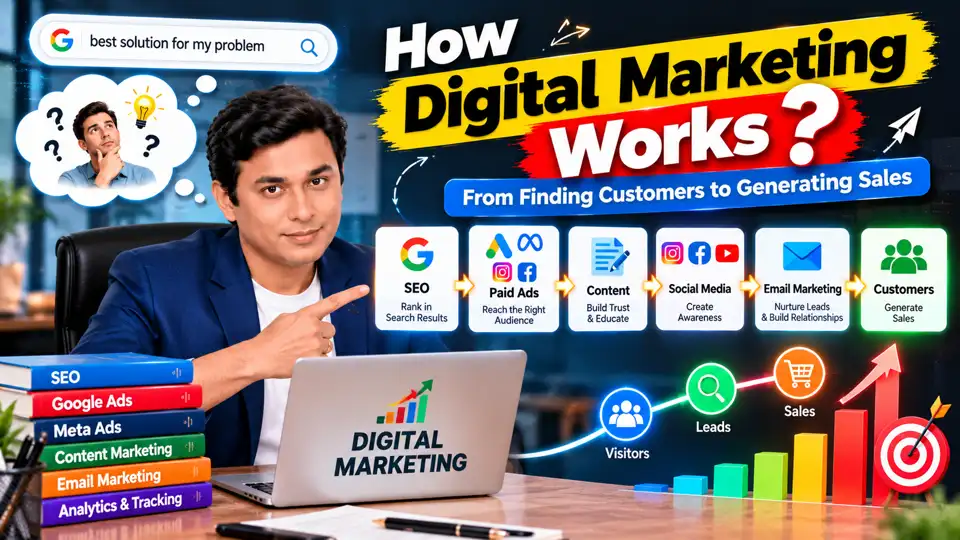
Everybody is searching for something. Someone wants to buy a new smartphone, someone is looking for a reliable doctor, and someone else wants to learn a skill that can improve their career. Today, many of these journeys begin on a search engine, social media platform, online marketplace, or AI-powered tool.
This shift has created an enormous opportunity for businesses. Customers are spending time in digital environments, researching their problems, comparing solutions, reading reviews, watching videos, and evaluating brands before making decisions.
But simply having a website or running advertisements is not enough. Businesses need to understand where their potential customers spend time, what motivates them to take action, and how to guide them from their first interaction to a purchase.
This is where digital marketing becomes valuable.
Digital marketing is the process of using online channels, content, advertising, and customer data to attract relevant audiences, build relationships, and achieve business goals.
Let's explore how digital marketing works, which channels businesses can use, and how these channels work together to turn online attention into measurable results.
What Is Digital Marketing?
Digital marketing involves promoting products, services, and brands through digital channels such as search engines, websites, social media, email, online advertising, and digital partnerships.
Think about a person who wants to purchase a new laptop. They may begin by searching for the best laptops within their budget. Next, they might watch product reviews on YouTube, read comparisons on blogs, visit ecommerce websites, and ask questions in online communities.
During this process, the person encounters different businesses and products. Each relevant interaction creates an opportunity for a business to earn attention and build trust.
A laptop retailer might attract this customer through a search-optimized article. Another retailer might reach them through a Google Ads campaign. A technology creator might introduce them to a product through a sponsored video. Later, a retailer could use permission-based email marketing to share relevant offers with a subscriber.
These activities use different channels, but they can contribute to the same business objective: helping a potential customer discover, evaluate, and purchase a product.
Digital marketing is therefore not just about visibility. It is about connecting the right message with the right audience at the right stage of the customer journey.
How Customer Search Behavior Creates Digital Marketing Opportunities
Before purchasing a product or service, customers often experience a need, problem, or desire. They then look for information that helps them make a decision.
For example, someone experiencing slow website performance might search for ways to improve website speed. A business owner struggling to generate leads might search for digital marketing agencies. A person planning a holiday might compare destinations, hotels, and travel packages.
These searches reveal valuable information about customer intent.
Understanding Search Intent
Search intent refers to the underlying reason behind a search query. Understanding it helps businesses create relevant content and advertisements.
Common search intents include:
- Informational intent: The user wants to learn something, such as how SEO works.
- Commercial investigation: The user compares available solutions, such as the best CRM software for small businesses.
- Transactional intent: The user is closer to taking action, such as purchasing a particular product.
- Navigational intent: The user wants to find a specific website or brand.
These categories can overlap, and not every search fits neatly into one group. However, they provide a useful framework for understanding what potential customers need.
A business selling accounting software, for instance, could publish an educational article about managing business expenses, create a comparison page for accounting tools, and run search advertisements for relevant high-intent queries.
Each asset addresses a different need. Together, they help the business reach customers at different stages of their decision-making process.
1. Search Engine Optimization: Attracting Customers Organically
Search engine optimization (SEO) helps businesses improve their visibility in organic search results.
When people search for answers, products, or services, search engines attempt to present useful and relevant results. Businesses can improve their chances of being discovered by publishing helpful content, building a technically accessible website, organizing information clearly, and earning relevant references from other websites.
Suppose you own a digital marketing agency. Potential customers might search for terms such as "digital marketing agency for small businesses" or "how to generate leads online."
You can create useful pages and articles that address these needs. If the content satisfies the searcher's intent and performs well against relevant ranking factors, it may attract visitors without requiring payment for every click.
Using Keywords to Understand Customer Needs
Keyword research helps identify the language people use when searching for information.
However, successful SEO is not about inserting as many keywords as possible into a page. It is about understanding the questions, concerns, and decisions behind those searches.
For example, a person searching for "what is email marketing" probably wants an explanation. Someone searching for "email marketing software pricing" is likely comparing solutions.
Creating content that matches these different needs can help a business attract more relevant visitors.
SEO can also support long-term customer acquisition. A useful article may continue attracting organic traffic for months or years, although rankings and traffic can change as competition and search systems evolve.
2. Paid Advertising: Reaching Potential Customers Faster
Organic visibility takes time to develop. Paid advertising allows businesses to pay for opportunities to reach audiences through platforms such as Google Ads and Meta Ads.
The key difference is that advertisers can select campaign objectives, define targeting parameters, set budgets, and measure performance.
Search Advertising
Search advertising can help businesses reach people who are actively looking for relevant products or services.
For example, a person searching for "emergency plumber near me" may need a service immediately. A plumbing company can use a relevant search campaign to appear for eligible searches in its service area.
Advertisers may bid on relevant keywords and pay according to the advertising model used by the platform, such as cost per click.
The actual cost depends on competition, targeting, ad quality, landing page experience, and other factors.
Social Media Advertising
Platforms such as Facebook and Instagram offer advertising opportunities based on campaign objectives, audience settings, placements, and available signals.
A clothing brand might use social media advertisements to introduce a new collection, encourage website visits, generate leads, or drive purchases.
Unlike search advertising, which can respond to an existing search query, social advertising often introduces products to people who were not actively searching for them.
Both approaches can be effective, but the campaign objective and creative should match the desired outcome.
Measuring Customer Acquisition Cost
Paid advertising also provides data that businesses can use to evaluate the cost of acquiring customers.
For example, if a business spends ₹20,000 on advertising and acquires 40 customers, its advertising cost per acquired customer is ₹500.
This calculation assumes those 40 customers can reasonably be attributed to the campaign. A complete analysis may also need to account for other marketing and sales expenses.
The important point is that clicks and impressions are not the final measure of success. Businesses should also evaluate leads, purchases, profit margins, and customer value.
3. Content Marketing and Online Communities: Building Trust
Not every customer is ready to purchase immediately. Some need information, reassurance, comparisons, or feedback from people who have already used a product.
Content marketing helps businesses address these needs by creating useful articles, videos, guides, case studies, and other resources.
Imagine someone considering a home water purifier. They might read product comparisons, watch installation videos, investigate maintenance costs, and look for customer experiences before making a decision.
A business can support this process by publishing transparent comparisons, explaining maintenance requirements, answering common questions, and sharing genuine customer experiences.
Online communities can also influence purchase decisions. People discuss problems, recommend solutions, and share their experiences on forums, social platforms, and review websites.
Businesses can learn from these discussions and participate where appropriate, provided they are transparent about their identity and commercial relationships.
Hidden promotional comments or fabricated reviews may damage trust and violate platform policies. Genuine participation and useful information provide a more sustainable approach.
4. Influencer Marketing: Connecting Through Established Audiences
Influencer marketing allows businesses to collaborate with content creators who have established relationships with particular audiences.
For example, a fitness equipment brand might partner with a fitness creator. A skincare business might collaborate with a beauty educator. A technology company might work with a creator who reviews gadgets.
These partnerships can help businesses introduce their products through demonstrations, tutorials, reviews, and sponsored content.
The effectiveness of influencer marketing depends on several factors, including audience relevance, creator credibility, content quality, campaign objectives, and the strength of the offer.
A creator with a smaller but highly relevant audience may generate more qualified customers than a creator with a much larger but less relevant audience.
Businesses should also establish clear deliverables, usage rights, reporting expectations, and disclosure requirements before beginning a collaboration.
5. Affiliate Marketing: Turning Partnerships Into Sales
Affiliate marketing is a performance-based marketing model in which publishers, creators, or other partners promote products and may earn commissions for qualifying actions, such as purchases.
For example, a website that publishes software comparisons could include affiliate links to the products it reviews. When a reader purchases through an eligible tracked link, the publisher may receive a commission under the program's terms.
Businesses benefit by working with partners who can introduce their products to relevant audiences. Affiliates gain an opportunity to earn revenue by creating useful content and generating qualifying referrals.
However, affiliate marketing requires careful management.
Businesses should establish clear guidelines covering brand representation, approved promotional methods, commission structures, tracking, and prohibited activities.
Affiliates should disclose material relationships and provide honest, useful information rather than making unsupported claims. Poor-quality promotional tactics can harm both the advertiser's reputation and the publisher's credibility.
When managed properly, affiliate marketing can extend a business's reach without relying exclusively on its own advertising channels.
6. Email Marketing: Building Relationships Over Time
Email marketing remains a useful way to communicate with people who have chosen to receive messages from a business.
Unlike advertising that depends on winning an auction every time it is delivered, email allows businesses to communicate directly with subscribers, subject to applicable consent, privacy, and marketing requirements.
Consider a person who downloads a free guide from a digital marketing agency. They may not need professional services immediately, but they have shown interest in improving their marketing.
With appropriate permission, the agency can send relevant educational emails, explain common marketing challenges, share useful resources, and introduce its services when appropriate.
How Email Automation Works
Email automation allows businesses to send messages based on predefined conditions or subscriber actions.
A simple sequence might include:
- A subscriber requests a guide and receives a delivery email.
- The subscriber receives a useful educational email a few days later.
- A follow-up email explains a related problem and possible solutions.
- The subscriber receives a relevant service offer or invitation to book a consultation.
More advanced systems may use tags, segments, and behavioral triggers to organize subscribers based on their interests and interactions.
For example, a subscriber interested in SEO training may receive different educational content from someone interested in paid advertising.
This makes communication more relevant and helps businesses avoid sending the same message to everyone.
Why Customer Segmentation Matters
Segmentation divides an audience into groups based on relevant characteristics or behavior.
Depending on the information collected with appropriate permission, a business might segment subscribers by interests, past purchases, signup source, or engagement with previous campaigns.
The goal is not to manipulate people through psychological pressure. It is to understand what information is useful to them and communicate accordingly.
Effective email marketing should provide value, respect subscriber preferences, and make unsubscribing straightforward.
7. Social Media Data, Tracking Pixels, and Retargeting
Social media platforms provide advertising tools that help businesses reach relevant audiences and measure certain actions.
One example is the Meta Pixel, a piece of code that can help a business website send eligible activity information to Meta for advertising measurement and optimization, subject to the applicable technical, privacy, and consent requirements.
Depending on the setup, a business may be able to measure actions such as product page views, add-to-cart events, or purchases.
This information can help advertisers understand which campaigns contribute to website activity and conversions.
How Retargeting Works
Retargeting allows businesses to reach eligible audiences who have previously interacted with their website, app, or other marketing assets.
For example, someone might visit an online store and view a pair of shoes without purchasing them. The store may be able to use an eligible audience and campaign setup to show that person a relevant advertisement later.
However, tracking and audience eligibility depend on factors such as user consent, platform policies, browser restrictions, technical implementation, and available data.
Businesses should not assume that every visitor can be tracked or retargeted.
What Are Lookalike Audiences?
Some advertising platforms offer tools that help advertisers find people who share characteristics with an existing source audience. Meta's Lookalike Audiences are one example.
A business might use an eligible customer list or another supported source to help find new people who resemble its existing audience.
The resulting audience is not guaranteed to contain people who will purchase. It simply provides another way to identify potential customers based on the platform's available signals.
Businesses should use these tools responsibly, follow data protection requirements, and evaluate performance through actual business outcomes.
8. Customer Journey Mapping: Connecting Marketing Channels
Each digital marketing channel plays a different role. SEO can introduce a business to new audiences, paid advertising can increase visibility, content can answer questions, and email can support ongoing communication.
Customer journey mapping helps businesses understand how these interactions may connect.
Consider a person looking for a digital marketing course.
First, they discover an educational article through a search engine. They visit the training provider's website and explore its course page. Later, they watch a social media video featuring the instructor. After comparing available options, they request more information and eventually enroll.
The journey may involve multiple interactions before conversion.
Why Attribution Matters
Attribution is the process of assigning credit to marketing interactions that contribute to a conversion.
For example, a business might discover that customers frequently visit its website through organic search but later convert after interacting with a paid advertisement.
The business needs to interpret this data carefully. Depending on the attribution model, reporting window, consent settings, and measurement limitations, different platforms may report different contributions to the same conversion.
This is why businesses should avoid assuming that one channel deserves all the credit.
Combining analytics data with customer feedback, CRM information, and sales records can provide a more complete picture of how marketing contributes to business outcomes.
9. The Metrics Every Digital Marketer Should Understand
Digital marketing generates large amounts of data, but collecting metrics is useful only when they help answer business questions.
Some important metrics include:
Cost per click (CPC): The average amount paid for each click under a cost-per-click advertising model.
Cost per lead (CPL): The average marketing cost associated with generating a lead.
Customer acquisition cost (CAC): The cost of acquiring a customer, calculated using a clearly defined set of marketing and sales expenses.
Conversion rate: The percentage of relevant visitors or users who complete a desired action.
Average order value (AOV): The average revenue generated per order.
Customer lifetime value (CLV or LTV): An estimate of the revenue or profit associated with a customer over the duration of the relationship, depending on how the business defines and calculates it.
Return on ad spend (ROAS): The revenue attributed to advertising divided by advertising spend.
These metrics should be interpreted together.
For example, a campaign may generate inexpensive leads, but if very few leads become customers, its overall performance may be disappointing. Another campaign may generate fewer leads at a higher cost but attract customers who purchase more frequently or generate higher profit margins.
The goal is not simply to make every metric look better. It is to understand which marketing activities create sustainable business value.
10. How to Build a Data-Driven Digital Marketing Strategy
Businesses do not need to use every digital marketing channel at once. A better approach is to start with a clear objective and build a strategy around the audience, offer, budget, and available resources.
Step 1: Identify Your Target Audience
Understand who is most likely to benefit from your product or service. Consider their needs, questions, buying behavior, and the problems they want to solve.
Step 2: Choose Relevant Marketing Channels
Select channels based on how your audience discovers and evaluates solutions. A local service provider may prioritize local SEO and search advertising, while an ecommerce brand may combine SEO, social media, email, and paid campaigns.
Step 3: Create Useful Digital Assets
Build landing pages, articles, videos, email sequences, and other resources that address the customer's needs at different stages of the decision-making process.
Step 4: Set Up Appropriate Measurement
Define the actions that matter to your business and configure analytics and conversion tracking responsibly. Verify that the data is accurate before using it to make decisions.
Step 5: Test and Improve
Test relevant elements such as advertising creatives, landing pages, messaging, and offers. Use sufficient data to evaluate results, and avoid treating small or short-term fluctuations as definitive evidence.
Step 6: Evaluate Business Outcomes
Review leads, purchases, customer acquisition cost, profit margins, and customer retention. Use the findings to decide where to invest more, what to improve, and which activities should be reduced or stopped.
Conclusion
Digital marketing is much more than publishing content, buying advertisements, or maintaining social media profiles. It is the process of connecting businesses with people who have relevant needs, helping those people evaluate available solutions, and building relationships that can lead to meaningful business outcomes.
Search engines reveal customer intent. Content marketing provides answers. Paid advertising creates additional opportunities for visibility. Influencers and affiliates introduce products through established relationships. Email marketing supports ongoing communication, while analytics helps businesses understand which activities contribute to results.
When these channels work together, businesses can create a more coherent customer journey and make better decisions about their marketing investments.
The most important principle is simple: understand your customer before choosing your marketing channel, measure outcomes rather than vanity metrics, and use data to improve the experience you provide.
That is how digital marketing becomes a business growth system rather than a collection of disconnected online activities.