
Uses your browser’s reading voice.
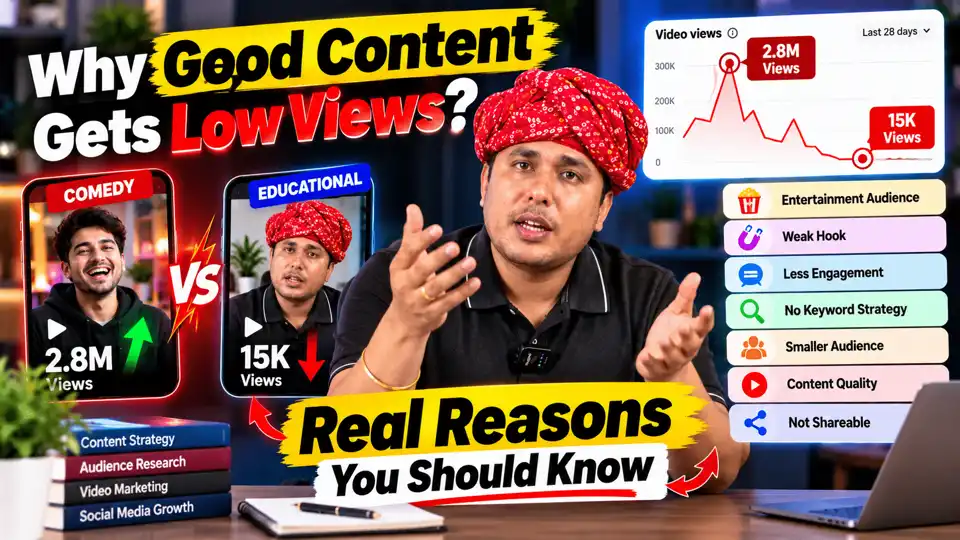
Good content doesn't always get good views—and that's the truth most creators learn the hard way.
You spend hours researching a topic, preparing a script, recording a video, editing it, and publishing it on social media. You expect people to watch, learn something, and engage with your content. But when you check the analytics, the views are disappointing.
Meanwhile, a comedy Reel with very little production effort receives thousands or even millions of views.
Why does this happen?
Many creators assume that low views mean their content is bad. However, content quality is only one part of the equation. Audience demand, entertainment value, opening hooks, discoverability, competition, presentation, and sharing behavior can all influence how many people watch a video.
In this article, I will explain seven important reasons why good content sometimes gets fewer views and what you can do to improve your content strategy without compromising its value.
1. Entertainment Content Often Has a Larger Potential Audience
One of the first things content creators need to understand is that people use social media for different reasons. Some want to learn something useful, while others want entertainment, relaxation, inspiration, or a quick laugh.
This difference in audience motivation can significantly affect the potential reach of a video.
For example, imagine two creators publishing Reels on the same day.
- Creator A explains how to optimize a website's title tags for SEO.
- Creator B publishes a relatable comedy video about everyday office life.
The SEO video may be extremely useful to website owners, digital marketers, and students learning SEO. However, the comedy video may appeal to a much broader range of people, including those who have no interest in digital marketing.
Consequently, the comedy video has the potential to attract a larger audience.
This does not mean entertainment content is inherently better than educational content. The two formats serve different needs and compete for different types of attention.
What Should Educational Content Creators Do?
Instead of abandoning educational content, make it easier and more enjoyable to consume.
For example, rather than creating a long introduction about keyword research, start with a relatable problem:
"You're publishing blog posts every week, but Google isn't sending you traffic. Here's one mistake you should check."
This approach introduces an educational topic through a problem that the intended audience understands.
You can also use storytelling, demonstrations, visual examples, humor, and relatable situations to make learning more engaging.
The goal is not to turn every educational video into comedy. It is to make valuable information interesting enough that people want to watch it.
2. Your Video's Hook May Not Be Strong Enough
The opening moments of a video can influence whether someone continues watching or scrolls to the next piece of content.
Social media users often make viewing decisions quickly. If your video takes too long to explain why it matters, viewers may leave before reaching the most valuable information.
Consider these two openings for a video about Instagram growth.
Weak opening:
"Hello everyone, welcome back to my channel. Today, we are going to discuss some important Instagram growth tips."
Stronger opening:
"Getting Instagram views but no followers? Your content may be attracting the wrong audience."
The second opening identifies a specific problem and creates a reason to continue watching.
How to Create a Strong Hook
A useful hook can take several forms:
- Problem-based: "Your website may be losing customers because of this mistake."
- Curiosity-based: "Most beginners misunderstand this part of SEO."
- Result-based: "Here's how to make your landing page easier to understand."
- Mistake-based: "Stop making this common mistake in your Google Ads campaigns."
- Relatable: "You spend hours editing a Reel, and it still gets only 200 views. Here's what to investigate."
These are starting points, not guaranteed formulas for virality.
Your opening should match the actual content. If you create curiosity but fail to deliver the promised answer, you risk disappointing viewers and damaging their trust.
Also, do not assume that every video must communicate its value within exactly three seconds. The ideal opening depends on the platform, format, topic, and audience. The practical principle is simple: make the purpose of your content clear as early as possible.
3. Your Content May Not Give People a Reason to Comment or Share
Creating useful content is important, but you should also consider how viewers might respond to it.
A video that invites people to contribute their experiences or opinions can create a more active conversation than a video that simply delivers information without encouraging participation.
For example, after explaining the difference between SEO and PPC, you could ask:
"Which would you prioritize for a new business with a limited budget: SEO or PPC? Tell me why."
This question gives viewers a specific topic to discuss.
Similarly, a video about Instagram growth could end with:
"What is your biggest challenge right now: getting views, gaining followers, or generating enquiries?"
People who relate to the question may be more willing to respond.
Does More Engagement Always Mean More Views?
No. Comments, likes, shares, and saves can provide useful signals about audience response, but no single engagement metric guarantees additional reach.
Recommendation systems consider multiple factors, which can vary by platform, content format, and individual viewer. A video may receive many comments without attracting a much larger audience, while another may be widely shared despite receiving fewer comments.
Focus on creating content that naturally encourages meaningful interaction rather than asking for engagement on every post.
You can also design content that people genuinely want to share. A practical checklist, a useful tutorial, or a relatable observation may give viewers a reason to send the video to a friend or colleague.
4. You're Targeting a Smaller Audience Than You Realize
Audience demand is another important factor that creators sometimes overlook.
Not every topic has the same number of interested viewers. Even excellent content may have limited reach when the subject appeals to a relatively small group of people.
Consider two educational topics:
- How to learn the abacus.
- How to prepare for government examinations.
Both topics can provide genuine value. However, government examination preparation may appeal to a much larger potential audience in a particular market, while abacus instruction serves a more specialized group.
This difference in potential audience size can influence the number of views each topic can attract.
However, audience size alone does not determine performance. Competition, search demand, content quality, audience intent, and the platform's distribution system also matter.
How to Evaluate Your Topic's Potential
Before creating content, ask yourself three questions:
- Who specifically needs this information?
- How many people are likely to be interested in the topic?
- What problem or question will make them look for this content?
You can use keyword research tools, platform search suggestions, audience comments, Google Trends, and relevant analytics to investigate demand.
For example, a digital marketing educator could research broad topics such as "digital marketing" and more specific questions such as "how to find freelance digital marketing clients."
The broader topic may have a larger potential audience, but the specific topic may attract viewers with a clearer need.
This is an important distinction: a smaller audience with strong interest can be more valuable than a large audience with little relevance to your goals.
5. Your Content May Be Difficult to Discover
Sometimes, the problem is not the content itself. The issue is that the right people are not finding it.
This is where keyword research and content discoverability become important.
People search for information using particular words and phrases. If your content addresses a topic but does not clearly communicate what it is about, it may be harder for the intended audience to discover it through search-driven features.
For example, a video titled "Important Tips You Need to Know" provides little information about its subject.
A title such as "How to Improve Website SEO for Beginners" communicates the topic much more clearly.
How to Use Keywords Effectively
Start by identifying the main question your content answers.
Then research relevant short-tail and long-tail keywords.
A short-tail keyword might be "Instagram marketing," while a long-tail keyword might be "how to increase Instagram followers organically."
Short-tail terms often cover broader topics, while long-tail terms usually express a more specific need. Their actual search demand and competition vary.
Use relevant phrases naturally in appropriate places, such as:
- Video titles and captions.
- Spoken explanations and on-screen text where appropriate.
- YouTube descriptions and tags, when relevant to the platform.
- Blog headings and page titles.
- Instagram captions and other descriptive content.
Do not stuff keywords into your content or add unrelated trending terms just to attract traffic.
Keyword optimization is not a guarantee of views. It helps communicate relevance and can support discovery, particularly on search-driven platforms. Recommendations, shares, audience behavior, and other factors also affect content distribution.
6. Your Content Quality and Presentation Need Improvement
A video can cover an excellent topic and still struggle if the information is confusing, the delivery is weak, or the presentation makes it difficult to follow.
Content quality is not just about camera resolution or expensive editing. It includes how well the video communicates its message and satisfies the viewer's expectations.
Consider a tutorial explaining how to create a Google Ads campaign.
One version spends two minutes discussing the importance of advertising before showing the process.
Another introduces the objective, demonstrates the key steps, explains common mistakes, and provides a practical example.
The second version may be easier for viewers to follow because it delivers useful information more directly.
Improve These Four Elements
Clarity: Explain one main idea at a time. Avoid unnecessary jargon unless your audience understands it.
Pacing: Remove repetitive explanations, long pauses, and introductions that delay the useful information.
Visual presentation: Use readable text, relevant screen recordings, demonstrations, and examples when they improve understanding.
Audience retention: Check where viewers stop watching and investigate whether those sections are too slow, confusing, repetitive, or unrelated to the main topic.
Watch time and retention are useful diagnostic metrics, but longer watch time does not automatically mean a video will receive more views. Different formats and platforms evaluate performance differently.
Your objective should be to help viewers understand and enjoy the content, not to artificially extend its duration.
7. Your Content May Be Valuable but Not Shareable Enough
Some videos are useful to the person watching them but do not naturally encourage that person to share them with others.
Other videos have an obvious sharing opportunity.
Comedy and roast videos, for example, may depict a relatable situation, make viewers laugh, or express an opinion that they want their friends to see. This can encourage people to tag others, send the video privately, or share it with their communities.
Educational content can also become highly shareable when it helps people solve a problem or communicate something useful.
For example, a Reel titled "Five SEO Mistakes That Can Hurt a Small Business Website" may encourage viewers to share it with a business owner who needs the information.
Similarly, a short explanation of a common tax, technology, or career-related question may be shared because it helps someone else.
Make Your Educational Content More Shareable
Try these approaches:
- Explain a common mistake and how to fix it.
- Turn a complicated topic into a simple visual demonstration.
- Provide a checklist viewers can use later.
- Use a real-world example that illustrates the lesson.
- Address a question your audience frequently asks.
- Explain a misconception without exaggerating the issue.
You do not need to sacrifice accuracy or professionalism to make content shareable. You need to make the value clear and relevant to the intended audience.
How to Improve Your Content Performance: A Practical Checklist
Before publishing your next video, use this checklist to evaluate whether it is ready.
- Audience: Is the video intended for a clearly defined group of people?
- Topic: Is the subject relevant to their interests or problems?
- Hook: Does the opening communicate why the video matters?
- Value: Does the video deliver useful information, entertainment, or insight?
- Pacing: Have you removed unnecessary introductions and repetition?
- Discoverability: Does the title or caption clearly describe the subject?
- Engagement: Is there a natural reason for viewers to comment, save, or share?
- Measurement: Do you know which metrics will help you evaluate performance?
After publishing, compare the results with your previous content. Review views alongside retention, shares, profile visits, audience relevance, and conversions where appropriate.
If the video underperforms, do not immediately assume that the topic is useless. Investigate whether the audience was too narrow, the opening was unclear, the content did not meet expectations, or the distribution was limited.
Use those observations to improve the next video.
Conclusion: Good Content Is About More Than Views
Good content does not always receive high views, and low views do not automatically mean that your content lacks value.
A video's performance depends on several factors, including audience demand, entertainment value, the opening hook, discoverability, presentation, and whether people find it worth sharing.
If you create educational content, focus on making it clear, engaging, useful, and relevant to the people you want to reach. Research your topics, improve your hooks, encourage meaningful discussion, and use analytics to identify opportunities for improvement.
Most importantly, understand the difference between reach and value.
A comedy video may attract a huge audience, while a specialized tutorial may reach fewer people but help them solve a meaningful problem.
For an educator, consultant, or business owner, those highly relevant viewers may be the people most likely to trust your expertise, return for more content, or become customers.
Don't judge the value of your content only by its view count. Sometimes, 1,000 right viewers are more valuable than 100,000 wrong viewers.
Create content for the audience you want to serve, improve it using evidence, and measure success according to your actual goals—not just the number displayed beneath your video.